


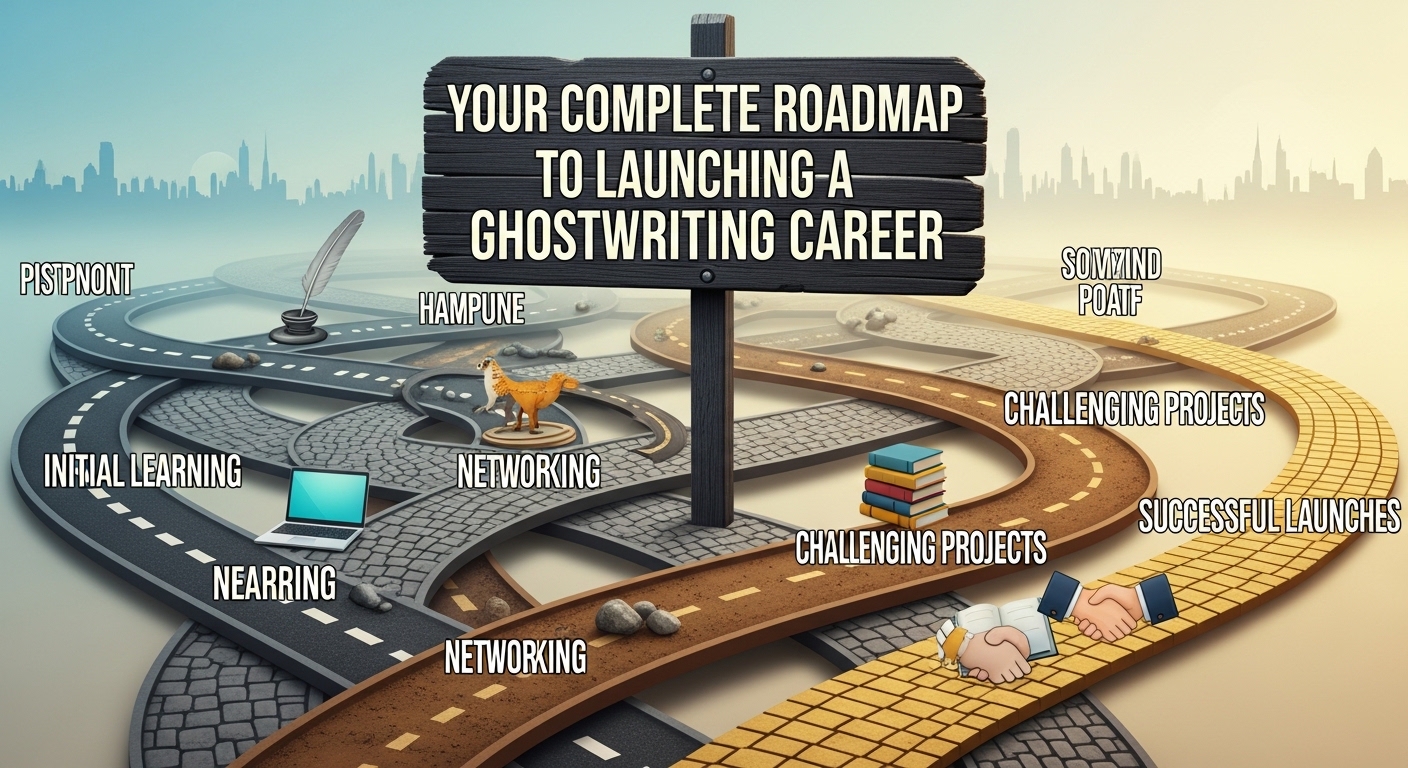
If you’ve ever scrolled through a bestseller list and wondered how busy CEOs, high-profile athletes, or tech innovators find the time to write 300-page books, here is the open secret: they usually don’t. They hire someone to do it for them.
Ghostwriting is one of the most profitable and intellectually stimulating paths a writer can take. It’s about more than just putting words on paper; it’s about capturing a human being’s essence and translating their expertise into a legacy. If you can write well and listen even better, you have the foundation for a career that is as rewarding as it is discreet.
What Is Your Complete Roadmap to Launching a Ghostwriting Career in 2026?
A ghostwriting roadmap is a strategic professional plan where you are hired to write content—books, articles, speeches, or even social media posts—that will be officially credited to someone else. In plain English, you are the “writer-for-hire.” You do the heavy lifting of interviewing, researching, and drafting, but when the project is finished, you hand over the authorship rights. You get paid for your skill, and the client gets the credit for the ideas.
This process is used everywhere in the modern world. For instance, a financial advisor might want to build credibility by turning their investment philosophy into a polished paperback but lacks the time to sit at a desk for six months. Similarly, a retired professional with incredible stories might hire a ghost to interview them and write their life story in their exact voice. Even in the digital space, busy founders hire ghosts to write their weekly thought-leadership posts based on quick voice notes sent during a commute.
Key Characteristics of Your Complete Roadmap to Launching a Ghostwriting Career in 2026
Voice Mimicry and Adaptation This is your primary skill. You aren’t writing as yourself; you are adopting the tone, vocabulary, and rhythm of your client. If they use short, punchy sentences in person, your writing must reflect that. If they are academic and long-winded, the manuscript must match that energy. Your job is to disappear into their personality so the reader never suspects a second party was involved.
Anonymity and Absolute Discretion Most ghostwriting involves strict Non-Disclosure Agreements (NDAs). You must be comfortable with the fact that your name won’t be on the cover and you often cannot publicly claim the work. This requires a professional ego-check; you are providing a service, and the satisfaction comes from the paycheck and the successful completion of a complex project rather than public accolades.
Interpersonal Intuition and Extraction You spend a lot of time “mining” for information. This isn’t just about transcription; it’s about knowing how to ask the right questions to get a client to open up about details they’ve forgotten. You act as a part-time journalist and part-time psychologist, digging beneath the surface to find the emotional core of the story that will actually resonate with a reader.
Structural Mastery and Narrative Flow Clients usually give you a “brain dump” of disconnected ideas, old blog posts, and random anecdotes. Your job is to find the “skeleton” of the story and build a logical flow. You take the raw materials of someone’s life or expertise and organize them into a compelling narrative arc that keeps a reader turning the page from start to finish.
Why Do People Hire Ghostwriters?
The primary motivation is often time scarcity. Successful people frequently have more money than time, and they value their ideas too much to let them sit in a drawer just because they can’t afford the hundreds of hours required to write a high-quality book. There is also a significant technical gap to consider; being an expert in a field like surgery or real estate doesn’t automatically mean someone knows how to structure a book or maintain a consistent tone over 50,000 words.
How to Get Started as a Ghostwriter
You don’t need a specific degree or a certification from a prestigious university to be a ghostwriter. In the professional world, your ability to deliver a clean, engaging manuscript matters far more than your formal credentials. If you can write a coherent article and hold a conversation, you can get started. The transition from “writer” to “ghostwriter” happens the moment you stop trying to sound like yourself and start trying to sound like someone else. It’s an encouraging path because it’s entirely merit-based; if you can do the work, you can get the job.
Refining Your Skills and Finding Your Niche
Don’t try to be a “writer for everything.” The most successful ghosts are specialists because specialization makes you an expert and allows you to charge more. If you understand the “language” of venture capital, you are much more valuable to a tech CEO than a generalist would be. You should pick a category—whether it’s business, fiction, or self-help—and study the conventions of that genre until you can replicate them in your sleep.
To practice, try the “Voice Exercise.” Take a 500-word article and rewrite it in three different styles: like a drill sergeant, like a friendly grandmother, and like a clinical scientist. This develops your mimicry muscles and teaches you how to identify the specific linguistic markers that make a voice unique. The goal is to reach a point where you can hear a client speak for ten minutes and immediately know how to translate that onto the page.
Building a Portfolio (The “Invisible” Way)
Since you can’t always show your ghosted work due to NDAs, you have to get creative with how you prove your value. One effective method is creating “White-Label Samples.” Write three “Chapter One” samples for imaginary clients, such as a gritty entrepreneur, a soulful artist, and a clinical doctor. Tag them clearly by genre so potential clients can see your range without you breaking any privacy agreements.
Gaining Experience as a Beginner
Don’t wait for a $30,000 book contract to land in your lap; start with the “Micro-Ghost” strategy. Offer to ghostwrite LinkedIn posts or newsletters for people in your professional network. It’s low-pressure, helps you practice working with a client’s “voice,” and allows you to learn the rhythm of client feedback. Another great entry point is beta reading and editing. Offering to edit manuscripts gives you a front-row seat to how books are structured before you have to build one from scratch yourself.
The Art of the Client Interview
The interview is where the book is actually “written.” You aren’t just following a script; you are practicing active listening. If a client mentions a “tough year,” don’t just move to the next question. Stop and ask what that year actually felt like on a Tuesday morning. Those sensory details are what make a book feel real. Always use reliable recording and transcription technology to capture their exact phrasing so you can pepper those “client-isms” into the draft for authenticit
Developing Your Signature Process
Having a set “way of doing things” makes you look like a seasoned professional even if you are relatively new. Start every project with a “Discovery Phase,” a 90-minute deep dive to see if you and the client actually click. Once you move forward, use a Milestone System. Break the book into four quarters and send the client 25% of the book at a time for feedback. This prevents you from writing an entire book only to find out the tone was wrong in the first chapter.
Mastering the “Voice” Audit
Before you write the first word, you need to conduct a thorough audit of how your client speaks. Look at their vocabulary inventory: do they say “utilize” or “use”? Do they prefer “challenging” or “hard”? You should also perform a rhythm analysis. Some people speak in long, flowing sentences with many sub-clauses, while others are punchy and direct. Your writing must mirror their natural breath and cadence to feel truly authentic to the person whose name is on the cover.
Navigating the Legal Side
You are a business owner now, so you must act like one by using solid contracts and NDAs. The Non-Disclosure Agreement protects the client’s privacy and your professional reputation, while a good contract protects your income. Ensure your agreement includes a “Termination Clause” that states what happens if the project is cancelled halfway through. You should always be paid for the work you completed, regardless of whether the client decides to finish the book.
Using Technology as a Creative Assistant
In 2026, the best writers use tools to speed up the “grunt work” so they can focus on the high-level storytelling. AI transcription tools can turn your interview recordings into text instantly, saving you dozens of hours of manual typing. Cloud collaboration tools allow you to work in shared documents where the client can leave comments in real-time. This keeps the feedback loop short and efficient, ensuring that you and the client stay aligned throughout the entire drafting process.
Managing Your Energy for Long-Term Projects
Writing a book is a marathon, and you cannot successfully sprint for 60,000 words without burning out. You should set aside “Deep Work Blocks” of 3–4 hours of uninterrupted time each morning when your brain is freshest. Ghostwriting requires a level of concentration that multitasking destroys. Additionally, follow the “Clean Break” rule: when you finish a chapter, walk away. You need to reset your own brain before switching back to your own voice or another client’s project.
How to Find Clients and Opportunities
In 2026, the best opportunities are found through direct relationships and specialized platforms rather than generic job boards. Use professional platforms like Reedsy that attract serious authors with established budgets. Strategic outreach is also powerful; find experts who are great at what they do but have a “quiet” online presence and offer to help them turn their ideas into a book. Finally, maintain a referral loop. Once you finish a project, always ask the client who else they know who has a story that needs to be told.
Recognizing Your Worth and Pricing Your Services
Pricing can be intimidating, but you must remember you are selling a high-value asset. Beginners often start with lower flat fees to build confidence, but as you grow, you should shift toward project-based pricing. Hourly rates actually penalize you for being fast and efficient. A project fee (e.g., $15,000 for a memoir) ensures you are paid for the final result and the value it brings. If a book helps a consultant land a high-paying speaking gig, your fee was a bargain.
Conclusion
The world is louder than ever, yet truly great stories are still rare. Ghostwriting is a unique opportunity to help the world’s most interesting people share their knowledge while building a career that offers freedom and high pay. If you’re willing to check your ego at the door and master the art of the interview, the path is wide open. 2026 is a fantastic time to start. The tools are better, the market is hungrier for authenticity, and the only thing missing is your pen. Go find a story that needs to be told, and start writing.
FAQs
1. Do I ever get cover credit?
Usually, no. You are a “silent partner.” In some cases, you might negotiate an “as told to” or “with” credit, but standard ghostwriting means the client owns 100% of the authorship. Typically, the less credit you take, the higher the fee you can charge.
2. What if the client isn’t a good storyteller?
That is exactly why they hire you. Your job is to be the “extractor.” Instead of asking for facts, ask for feelings and sensory details. You act as a filter, turning their raw expertise into a compelling narrative.
3. What if they hate the first draft?
Prevent this by using a milestone system. Never write the whole book in a vacuum. Send an outline first, then a sample chapter, then the first 25%. Frequent check-ins ensure the tone stays on track and eliminates “draft shock.”
4. How long does a book take to write?
A standard 50,000-word manuscript usually takes 4 to 9 months. This includes the interview phase, the heavy drafting period, and at least two rounds of deep polishing and revisions.
5. nWill AI replace me in 2026?
No. AI can’t sit across from a human and sense the emotion in their voice or uncover a hidden memory. Use AI for transcription and outlining, but rely on your human empathy and intuition for the actual storytelling.


