


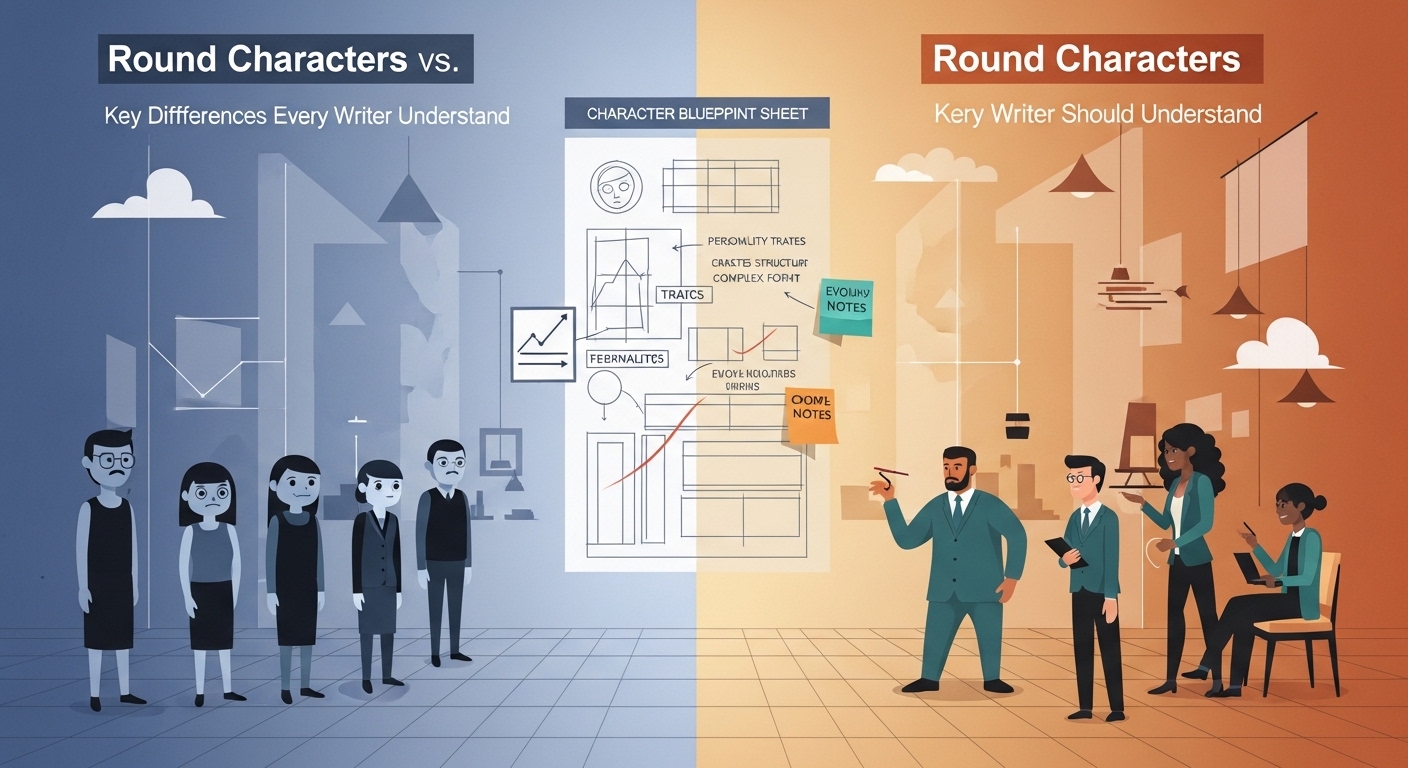
Characterization is one of the most important elements of storytelling. A story can have a strong plot, beautiful writing, and an interesting setting, but without well-developed characters, it rarely feels meaningful or memorable. Readers connect with characters more than anything else, and the way those characters are built directly affects how engaging the story becomes.
Among the most essential concepts in character development are round characters and flat characters. These two categories help writers understand how deeply a character is developed and what role they play in a story. Knowing the difference is not just theoretical—it directly impacts how you write believable, engaging fiction.
What Are Round Characters?
Round characters are complex, layered, and psychologically rich. They feel like real people because they have depth, contradictions, emotions, and evolving perspectives. These characters are not defined by a single trait or behavior. Instead, they are shaped by multiple influences such as background, experiences, beliefs, and internal conflict.
A round character is capable of change. As the story progresses, they may grow, shift their thinking, or struggle with decisions that reflect inner conflict. This unpredictability is what makes them compelling to readers.
In many stories, the protagonist is usually a round character because the narrative revolves around their emotional and psychological journey. However, important supporting characters can also be round if they significantly influence the story’s emotional depth.
Characteristics of Round Characters
Round characters are defined by depth and realism rather than simplicity. They often feel unpredictable because they behave in ways that are consistent with human complexity rather than narrative convenience.
They typically have clear motivations that are not always straightforward. These motivations may conflict with each other, creating internal tension. For example, a character may want success but also fear the cost of achieving it.
Another important feature is emotional range. Round characters do not react in a single, fixed way. Their responses vary depending on context, relationships, and personal experiences. This emotional variation makes them feel more authentic.
Round characters also evolve over time. Their beliefs, priorities, or attitudes may shift as they experience events within the story. This growth is often central to the narrative itself.
What Are Flat Characters?
Flat characters are simpler and more one-dimensional compared to round characters. They are usually defined by a single trait, idea, or role within the story. Instead of being fully developed individuals, they often serve a specific narrative purpose. This does not mean flat characters are “bad” or unimportant. In fact, they are extremely useful in storytelling when used correctly. Their simplicity allows the focus to remain on the main plot or on more complex characters.
Flat characters are often stable and predictable. They do not undergo significant internal change, and their behavior remains consistent throughout the story. This makes them easy for readers to understand quickly.
Characteristics of Flat Characters
Flat characters usually revolve around one dominant trait or function. For example, a character might exist primarily as a source of comic relief, a strict authority figure, or a loyal companion without much personal development.
They are typically predictable in behavior. Once the reader understands their role, there is little surprise in how they will react in different situations.
Flat characters also tend not to experience deep internal conflict. Their motivations are usually straightforward, and they rarely undergo significant transformation.
Because of this simplicity, flat characters are often used in supporting roles where emotional depth is not necessary for the story’s progression.
Key Differences Between Round and Flat Characters
The distinction between round and flat characters is not about quality but about depth and narrative function. Each serves a different purpose in storytelling, and understanding their differences helps writers use them more effectively.
Round characters are multi-dimensional, while flat characters are focused and simplified. Round characters evolve over time, whereas flat characters remain mostly unchanged. Round characters often carry emotional complexity, while flat characters are defined by clarity and consistency. In storytelling terms, round characters drive emotional engagement, while flat characters support structure and pacing.
To make this clearer, consider the following comparison:
| Aspect | Round Characters | Flat Characters |
| Depth | Complex and layered | Simple and focused |
| Development | Evolves over time | Remains mostly stable |
| Purpose | Drives emotional story | Supports plot or roles |
| Behavior | Unpredictable at times | Predictable and consistent |
| Role in story | Central or impactful | Secondary or functional |
This distinction helps writers decide how much detail a character needs based on their role in the narrative.
Why Round Characters Matter in Storytelling
Round characters are essential because they create emotional connection. Readers are more likely to stay engaged when they feel that characters are real, unpredictable, and emotionally layered.
These characters also make stories more immersive. When a character has internal conflict, changing motivations, or personal growth, the story feels more realistic and meaningful. Another important role of round characters is driving the plot forward. Because they are complex, their decisions often create tension, consequences, and unexpected developments in the story. In many cases, the emotional core of a story exists entirely within a round character’s journey.
Why Flat Characters Still Matter
Although flat characters lack depth, they play an important structural role in storytelling. Not every character in a story needs to be deeply developed. In fact, too many complex characters can make a story confusing or emotionally overwhelming.
Flat characters help maintain balance. They provide clarity, support the main narrative, and allow round characters to stand out more effectively. They are often used for specific functions such as guiding the protagonist, representing a fixed idea, or providing contrast to more complex characters. In many stories, flat characters act as background structure that supports pacing and storytelling focus.
How Writers Use Both Types Effectively
Strong storytelling rarely relies on only one type of character. Instead, writers strategically combine round and flat characters to create balance Round characters are usually placed at the center of the narrative, where emotional depth and transformation are required. Flat characters are placed around them to support the story structure without overwhelming it.
For example, a protagonist may be a round character with complex motivations, while supporting figures such as mentors, guards, or minor acquaintances remain flat to keep the focus on the main journey. This balance ensures that the story remains both engaging and easy to follow.
How to Decide If a Character Should Be Round or Flat
Choosing between round and flat characters depends on their role in the story. If a character is central to the plot or emotional development, they should be more detailed and layered. If their role is functional or limited, simplicity is often more effective. A useful way to decide is to ask whether the character needs to change or whether they simply need to support the story. If change is important, the character should be round. If not, a flat character may be more appropriate.
This decision helps maintain clarity in storytelling and prevents unnecessary complexity.
Frequently Asked Questions (FAQs)
What is the main difference between round and flat characters?
The main difference is depth. Round characters are complex and change over time, while flat characters are simple and remain mostly unchanged throughout the story.
Are flat characters bad for storytelling?
No, flat characters are not bad. They are useful for supporting roles, maintaining clarity, and balancing more complex characters in a story.
Can a supporting character be round?
Yes, supporting characters can be round if they have emotional depth, internal conflict, or a significant impact on the story’s development.
Why are round characters important?
Round characters create emotional engagement, realism, and narrative depth, making stories more immersive and meaningful.
How do I know if my character is flat or round?
If a character has depth, evolving emotions, and complexity, they are round. If they have a single defining trait and remain unchanged, they are flat.


