


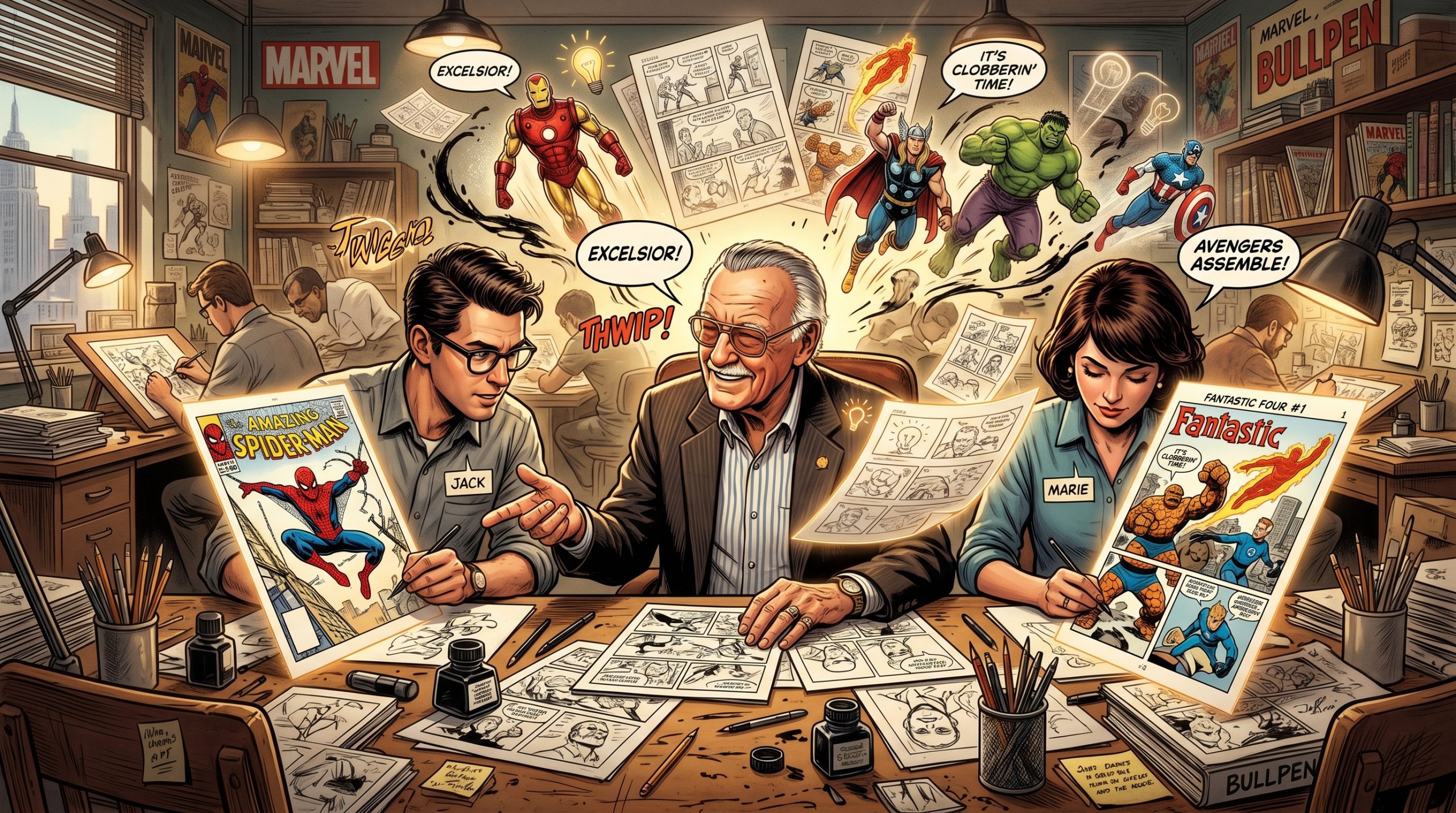
When people ask “How did Stan Lee create his characters?” they are usually not just asking about comic book history—they are trying to understand how an entire universe of superheroes came to feel so alive, so flawed, and so emotionally real.
Because before Marvel became a global entertainment empire, it was a small comics division trying to survive in a competitive publishing world. And at the center of its transformation stood Stan Lee, a writer-editor who didn’t just invent superheroes—he redefined what superheroes could be.
Instead of untouchable gods, his characters argued, worried about rent, struggled with identity, made mistakes, and sometimes failed. That shift didn’t happen by accident. It was the result of a unique creative system, relentless deadlines, collaborative artistry, and a surprisingly simple philosophy: if readers can see themselves in a hero, they will care about the story forever.
Understanding Stan Lee’s process is not about a single formula. It’s about a blend of storytelling instinct, collaboration, improvisation, and an almost chaotic creative environment that somehow produced some of the most iconic characters in fiction history.
The Creative World That Shaped Stan Lee
To understand Stan Lee’s character creation process, it helps to understand the environment he worked in. During the 1960s, Marvel Comics was not yet the cultural powerhouse it would become. It was a small, fast-paced publishing house competing with DC Comics, which dominated the superhero landscape with polished, archetypal figures like Superman and Batman.
Marvel needed something different—not just new characters, but new emotional energy.
Stan Lee, working alongside artists like Jack Kirby and Steve Ditko, began pushing against the established formula. Instead of perfect heroes, they created flawed individuals with psychological depth. This was not just a creative choice—it was also a production necessity. Comics were produced quickly, often under tight deadlines, which forced Lee and his collaborators to think fast, iterate constantly, and rely heavily on visual storytelling.
That pressure became a catalyst for innovation.
The Marvel Method: A Revolutionary Way of Creating Characters
One of the most important answers to how Stan Lee created his characters lies in what became known as the Marvel Method.
Unlike traditional comic writing, where a writer scripts every panel in detail, the Marvel Method worked more like a creative partnership between writer and artist.
In simplified terms, it worked like this:
Stan Lee would outline a story idea—sometimes just a paragraph or a few pages of notes.
The artist would then draw the entire comic, determining pacing, action, and visual storytelling.
Afterward, Lee would add dialogue, narration, and character voice over the completed artwork.
This process fundamentally shaped how characters were born. Because artists like Jack Kirby and Steve Ditko had enormous creative freedom in visual storytelling, many character traits, personalities, and even narrative beats emerged visually first.
For example, Spider-Man’s agility, posture, and visual identity were not just written—they were drawn into existence and then verbally refined.
This system meant that Stan Lee was not the sole “creator” in the modern sense. Instead, he functioned as a narrative architect, shaping tone, personality, and emotional resonance around visual concepts developed collaboratively.
Character Creation as Emotional Engineering
One of Stan Lee’s most important contributions was his focus on emotional relatability.
Instead of asking, “What powers should this hero have?” he often asked:
- What personal problem does this character struggle with?
- What insecurity drives them?
- What would make them feel human, even with extraordinary abilities?
This approach fundamentally changed superhero storytelling.
Superpowers became secondary to personality flaws. Characters were designed around emotional tension rather than just spectacle.
For example, rather than simply creating a “strong hero,” Lee and his collaborators would build someone who is strong but emotionally conflicted, or powerful but socially isolated. That emotional contradiction became the engine of the story.
Case Study: Spider-Man and the Birth of Relatable Heroism
Perhaps the clearest example of Stan Lee’s character philosophy is Spider-Man.
At the time, teenage superheroes were usually sidekicks. The idea of a teenage protagonist carrying an entire series was considered commercially risky. But Stan Lee and Steve Ditko saw an opportunity.
Spider-Man wasn’t designed as a fantasy of power. He was designed as a fantasy of responsibility under pressure.
Peter Parker was:
- socially awkward
- financially struggling
His powers didn’t solve his problems—they complicated them. This inversion was critical. Instead of becoming confident after gaining abilities, Peter Parker became more burdened. That emotional layering made Spider-Man feel unprecedented in superhero fiction. The famous principle—“with great power comes great responsibility”—is not just a moral lesson. It is a structural reflection of Lee’s character design philosophy: power must create conflict, not eliminate it.
The Fantastic Four: Imperfect Heroes as a Team Dynamic
Before Spider-Man, Stan Lee and Jack Kirby created the Fantastic Four, often considered the first true Marvel superhero team in the modern sense. Unlike traditional teams of flawless heroes, the Fantastic Four were built like a dysfunctional family.
Each member had a distinct emotional identity:
- Reed Richards (Mr. Fantastic): brilliant but emotionally distant
- Sue Storm (Invisible Woman): often underestimated but internally strong
- Johnny Storm (Human Torch): impulsive and attention-seeking
- Ben Grimm (The Thing): physically monstrous but emotionally sensitive
The key innovation here was not their powers, but their interpersonal tension. They argued, disagreed, and struggled with their roles within the group. Stan Lee’s character creation process here focused on group psychology rather than individual heroism. The story wasn’t just about fighting villains—it was about navigating relationships under extraordinary circumstances.
The X-Men: A Metaphor for Social Alienation
The X-Men introduced an even deeper layer to Stan Lee’s character philosophy: social metaphor. Mutants were not just superheroes. They were outsiders born with traits that society feared or rejected.
Each character embodied a different form of alienation:
- Cyclops: burdened leadership and emotional restraint
- Jean Grey: power intertwined with instability
- Wolverine: rage, trauma, and fragmented identity
The X-Men were designed to reflect real-world issues like discrimination, identity, and belonging. While Stan Lee and his collaborators did not always explicitly frame it this way in early development, the emotional architecture of the characters naturally aligned with social metaphor storytelling. This is a key insight into Lee’s method: characters often evolved into symbolic representations of human experience after their initial conception.
The Hulk: Emotional Extremes as Character Design
The Hulk is another foundational example of Stan Lee’s creative process.
Bruce Banner is not just a scientist who transforms into a monster. He is a character built around emotional suppression and uncontrolled release.
The core idea is simple but psychologically rich: intelligence and rage exist in conflict within the same individual.
The Hulk represents emotional overflow—what happens when restraint fails completely.
This duality was a deliberate narrative choice. Instead of designing a hero with a clear identity, Lee and Kirby created a fractured psychological system embodied in one character.
Iron Man: Technology, Ego, and Reinvention
Iron Man reflects another dimension of Stan Lee’s approach: character evolution through internal contradiction.
Tony Stark begins as a weapons manufacturer, someone complicit in systems of destruction. His transformation into Iron Man is not just physical—it is moral and psychological.
The character is built on tension between:
- ego and vulnerability
- wealth and responsibility
- intelligence and emotional avoidance
While multiple creators contributed to Iron Man’s development, Stan Lee’s influence is evident in the emphasis on personal transformation driven by crisis rather than destiny.
Creativity Under Pressure: Deadlines as a Design Tool
One of the most misunderstood aspects of Stan Lee’s creative output is how deeply it was shaped by production pressure. In modern creative culture, deadlines are often treated as obstacles to quality. In early Marvel Comics, they functioned almost like a creative engine.
Marvel’s publishing schedule was unforgiving. Issues had to be completed on a continuous cycle, which meant there was no luxury of extended ideation phases or prolonged character development retreats. Instead, ideas had to be formed, tested, and published rapidly.
This constraint had a surprising effect: it eliminated perfectionism as a bottleneck.
Speed as a Catalyst for Character Emergence
When time is limited, creators rely more heavily on instinct than over-analysis. Stan Lee’s process adapted to this environment by prioritizing functional storytelling over theoretical completeness.
Rather than asking whether a character concept was “fully developed,” the working question became:
Does this idea work right now on the page?
If the answer was yes, it moved forward. If not, it was adjusted immediately in the next iteration.
This created a feedback loop where characters evolved organically through publication rather than pre-planning. Many Marvel characters were essentially refined in real time, issue by issue.
Iteration Instead of Finalization
In traditional character development, creators aim for a fully formed concept before production begins. Stan Lee’s environment inverted that logic.
Characters were treated as living drafts:
- Personality traits could be amplified if readers responded positively
- Weak narrative elements were quietly reworked in later issues
- Visual identity and dialogue often evolved independently before aligning
This iterative system is a major reason Marvel characters feel psychologically layered. They were not locked into a single “final version” at conception—they were continuously reshaped by storytelling necessity and audience reaction.
Dialogue as Character Identity
Stan Lee’s contribution to character creation is often reduced to “writing funny dialogue,” but that significantly underestimates its structural importance. Dialogue in Marvel comics was not decoration—it was identity architecture.
Speech as Psychological Fingerprint
Each major character was given a distinct verbal rhythm that communicated personality faster than exposition ever could. This was crucial in a visual medium where space was limited and pacing had to remain tight.
Stan Lee used dialogue to encode psychological traits:
- Witty banter often signaled intelligence mixed with insecurity (e.g., Spider-Man)
- Formal or elevated speech suggested intellectual distance or emotional restraint (e.g., Reed Richards)
- Aggressive or fragmented speech patterns reflected internal conflict or instability (e.g., Hulk)
- Self-aware humor created relatability even in extraordinary contexts
This meant readers could “hear” a character’s personality before fully understanding their backstory.
Dialogue as Emotional Conflict Engine
Beyond identification, dialogue also served a structural purpose: it externalized internal conflict.
Instead of narrating emotional struggle, Stan Lee often let characters argue with each other—or even with themselves in monologue form. This turned conversations into psychological battlegrounds, where ideology, insecurity, and motivation collided in real time.
For example, Spider-Man’s humor is rarely just comedic—it is often a defense mechanism masking anxiety or responsibility pressure. That dual function (surface tone + emotional subtext) is a hallmark of Lee’s writing approach.
Mythology Meets Modern Psychology
One of the most sophisticated aspects of Stan Lee’s character creation system was his ability to merge mythological archetypes with modern psychological realism without making the result feel abstract or symbolic.
Archetypes Reimagined in Contemporary Contexts
Classical mythology often revolves around archetypal figures: heroes, tricksters, monsters, and tragic beings shaped by fate or divine influence. Stan Lee did not abandon these structures—he relocated them.
Instead of gods and demigods operating in mythic landscapes, Marvel characters inhabit:
- metropolitan cities
- scientific laboratories
- political and social systems
- media-saturated environments
This grounding in modern settings transformed archetypes into psychologically plausible individuals.
Psychological Depth as Modern Myth
What makes this fusion particularly effective is that Stan Lee’s characters do not merely represent archetypes—they struggle against them.
A few examples of this dynamic:
- A hero burdened by responsibility but trying to live a normal life (Spider-Man)
- A brilliant mind emotionally detached from personal relationships (Mr. Fantastic)
- A creature defined by rage but longing for control and acceptance (Hulk)
- Outsiders whose identity becomes politicized by society’s fear (X-Men)
This creates a layered storytelling structure where mythology operates underneath psychological realism rather than replacing it.
Why This Combination Endures
The fusion of myth and psychology is one reason Marvel characters translate so effectively across media. They are simultaneously:
- symbolic enough to feel universal
- human enough to feel intimate
- flexible enough to evolve across decades
This balance is not accidental—it is embedded in the original character construction logic.
The Legacy of Stan Lee’s Character Creation Method
Stan Lee’s influence on storytelling extends far beyond comic books. What he ultimately helped establish was not just a collection of memorable superheroes, but a durable creative system for building fictional worlds where characters feel emotionally alive, internally conflicted, and capable of evolving over time. That system has since been absorbed into nearly every major form of modern narrative entertainment, often without being explicitly recognized as part of its foundation.
At the heart of this legacy is a shift in storytelling logic. Instead of treating characters as fixed designs that serve a plot, Stan Lee’s approach helped normalize the idea that characters are emotional organisms—structures that grow, contradict themselves, and change under pressure. This principle now quietly shapes how stories are written across multiple industries.
Influence on Modern Storytelling Formats
The most visible impact of Stan Lee’s character creation philosophy can be found in contemporary superhero cinema. These films no longer treat superhuman abilities as the central attraction. Instead, powers function as narrative pressure points that expose insecurity, responsibility, trauma, and identity conflict. The spectacle is still present, but it is emotionally anchored.
A character’s strength is rarely interesting on its own; what matters is what that strength costs them psychologically. This reflects the same core logic that Marvel comics developed in their early years, where abilities were designed to intensify internal struggle rather than replace it.
Serialized television evolved in a similar direction, though through a slightly different pathway. Modern long-form series tend to prioritize continuous character development rather than episodic resets. Characters are allowed to carry emotional consequences forward across seasons, and their identities are shaped through accumulation rather than repetition.
This mirrors the way early Marvel characters were refined issue by issue, where each new story functioned as an adjustment to an ongoing psychological profile rather than a self-contained reset. The result is a storytelling model in which transformation is gradual, often uneven, and deeply tied to relational dynamics.
Graphic novels and mainstream comics have expanded this principle even further. Reinvention has become a structural norm rather than an exception. Characters are frequently reinterpreted across different writers, timelines, and narrative reboots, creating layered identities that coexist rather than replace one another.
Why This Legacy Endures
Across all these mediums, the underlying transformation remains consistent. Storytelling has shifted away from purely plot-driven construction toward systems where character behavior generates narrative momentum. This is one of the most important long-term effects of Stan Lee’s approach. Characters are no longer static vehicles for story delivery; they are treated as evolving psychological frameworks that shape the direction of the story itself.
What makes this legacy particularly durable is its flexibility. It does not depend on a specific genre, medium, or production style. Instead, it operates as a general principle of narrative design: emotionally coherent characters create stronger engagement than structurally perfect but emotionally distant ones. Whether in film, television, comics, or interactive media, this principle continues to guide how audiences connect with fiction.
The Core Principle Behind His Legacy
At the center of Stan Lee’s creative philosophy is a deceptively simple idea:
Characters become meaningful when they behave like people under pressure, not concepts under control.
This principle reshapes how fiction is constructed:
- Story does not define character; character defines story direction
- Conflict is not external first—it is internal first
- Dialogue is not explanation—it is identity in motion
- Imperfection is not a flaw—it is the foundation of relatability
Collaboration as a Creative Multiplier
Another critical element of his legacy is the collaborative nature of his process. Stan Lee did not operate as an isolated creator but as part of a creative ecosystem where writers, artists, and editors influenced each other continuously.
This means Marvel characters are not the product of a single imagination, but of structured creative tension—where ideas were constantly negotiated between visual and narrative thinking.
That tension is part of why the characters feel dynamic rather than static.
Why This Method Still Works Today
Even in modern digital storytelling environments, Stan Lee’s approach remains highly relevant because it aligns with how audiences actually engage with fiction.
Readers and viewers today expect:
- emotional realism even in fantasy settings
- character growth that feels earned, not pre-planned
Stan Lee’s system naturally produces these outcomes because it is built around process-driven character evolution rather than rigid pre-design. Stan Lee’s greatest creative achievement was not simply the invention of iconic superheroes. It was the development of a character creation philosophy that treats fictional individuals as evolving psychological systems rather than fixed designs. By combining speed, collaboration, mythological structure, and deeply human dialogue, he created a method where characters do not just exist—they develop, react, and transform in ways that mirror real human experience.
That is why his characters continue to feel alive decades later: they were never designed to be finished objects. They were designed to keep changing.
FAQ: How Did Stan Lee Create His Characters?
1. Did Stan Lee create all Marvel characters alone?
No. Most Marvel characters were co-created with artists like Jack Kirby and Steve Ditko. Stan Lee contributed story direction, dialogue, and character development, while artists often shaped visual identity and narrative structure.
2. What is the Marvel Method?
The Marvel Method is a collaborative storytelling process where the writer provides a loose plot, the artist draws the full story, and the writer later adds dialogue and captions. This allowed significant creative input from artists.
3. Why are Stan Lee’s characters so relatable?
Because they are built around human flaws, emotional struggles, and everyday problems rather than perfection, their powers amplify, rather than erase, personal conflict.
4. What was Stan Lee’s main philosophy in character creation?
He believed superheroes should feel human. Emotional relatability was more important than power level or visual spectacle.
5. Which characters best represent Stan Lee’s style?
Spider-Man, the Fantastic Four, the X-Men, Hulk, and Iron Man are some of the strongest examples of his character-driven storytelling approach.
6. Did Stan Lee plan long character arcs in advance?
Not usually. Many characters evolved organically through collaboration, feedback, and ongoing storytelling rather than rigid long-term planning.
Conclusion: Characters Built From Imperfection
So, how did Stan Lee create his characters?
Not through a single formula, but through a dynamic process of collaboration, improvisation, emotional design, and relentless iteration. His greatest innovation was not inventing superheroes with powers—it was designing human beings who happened to live in extraordinary worlds.
By blending mythic structure with psychological realism, and by embracing collaboration over control, Stan Lee helped redefine what storytelling could achieve.
And that is why his characters still feel alive today—they were never meant to be perfect. They were meant to feel real.


