


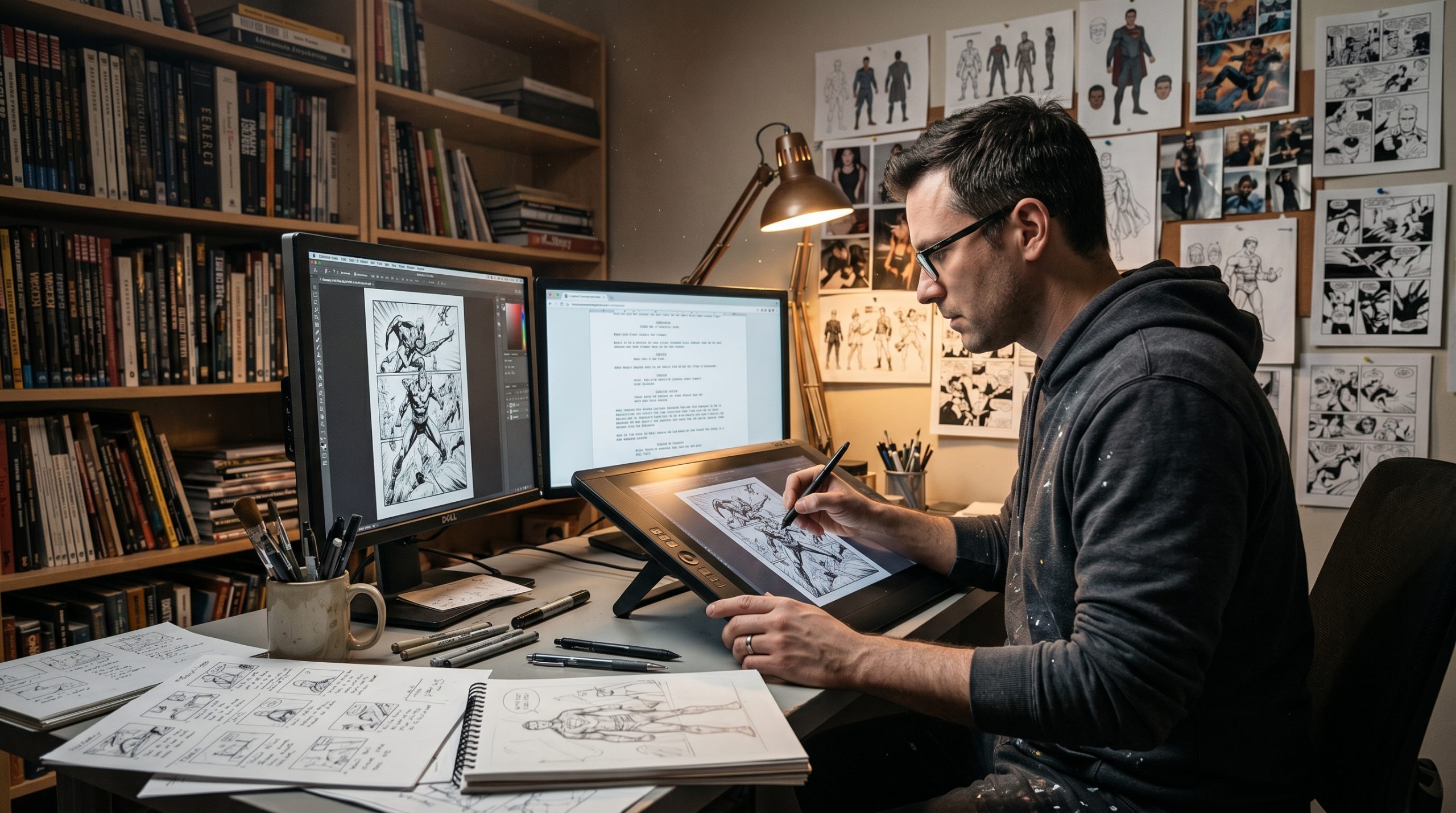
Sometimes it starts with a single character. Sometimes it begins with a world, a conflict, or a question that refuses to leave your imagination. You may have a compelling superhero concept, a dark fantasy universe, a science-fiction saga, or a graphic memoir waiting to be brought to life.
Between inspiration and publication lies the real work of creation: shaping narrative structure, building memorable characters, designing visual storytelling, pacing scenes across panels, and crafting artwork that captures readers from the very first page. This is where a professional comic book writer and illustrator becomes essential.
Many aspiring publishers, entrepreneurs, storytellers, entertainment brands, and independent creators underestimate how technically demanding comic development truly is. Writing a compelling script requires mastery of narrative pacing. Illustration demands advanced artistic skill, panel composition, visual consistency, and emotional expression. Whether you’re developing a graphic novel, launching an indie comic series, adapting an existing story into sequential art, or building intellectual property for publication, film adaptation, or digital distribution, working with the right comic book writer and illustrator can elevate your vision from concept to professionally executed reality.
This guide explores why professional comic creation matters, what a comic book writer and illustrator brings to your project, what to look for when hiring one, and how expert creative collaboration can shape stories readers remember long after they turn the final page.
What Does a Comic Book Writer And Illustrator Do?
A comic book writer and illustrator is a multidisciplinary creative professional who transforms ideas into fully realized visual narratives. Unlike traditional writers who work primarily with text, or illustrators who focus solely on visuals, this role operates at the intersection of storytelling and sequential art.
Their work is not just about writing scripts or drawing characters. It is about constructing an integrated storytelling system where words, images, pacing, and visual composition work together to guide the reader through a controlled emotional and narrative experience.
Every decision—from dialogue placement to panel layout—affects how the story is perceived.
To understand this role clearly, it is important to break it down into the core stages of comic creation.
Story Concept Development
Every comic begins with an idea, but not every idea is ready to become a story. This is where concept development becomes essential.
At this stage, a comic book writer and illustrator help refine and structure the raw idea into a workable narrative foundation. This involves defining the core premise, identifying central themes, establishing genre expectations, and shaping the emotional direction of the story.
They also help clarify who the story is for and what kind of experience it should deliver to the reader. A concept like “a futuristic detective solving crimes in a cyberpunk city” is only the starting point. Through development, it becomes a structured narrative with defined stakes, tone, and identity.
The key value here is distinction. A professional creator identifies what makes the idea unique and ensures that the final concept has a strong narrative hook capable of sustaining a full comic.
Script Writing and Narrative Structuring
Once the concept is defined, the next stage is script development, which is one of the most technically specific parts of comic creation.
Comic writing is fundamentally different from novels, screenplays, or general content writing. It is built around visual pacing and spatial storytelling. Every page and every panel must serve a precise narrative function.
A professional comic script typically includes detailed panel descriptions that guide visual composition, dialogue that reflects character voice and tone, and narrative cues that support transitions between scenes. It also includes careful attention to page-turn moments, which are used strategically to build suspense or deliver impact.
Unlike prose writing, where description can be expansive, comic scripts must remain efficient. The writer must constantly balance clarity with visual economy, ensuring that the illustrator has enough direction without overloading the page with unnecessary detail.
A skilled comic book writer understands how to structure momentum across pages so that the story feels continuous, cinematic, and emotionally engaging.
Character Creation and Visual Design
Characters are the emotional core of any comic. Readers often connect with characters before they fully understand the plot, which makes visual and narrative character design extremely important.
A comic book writer and illustrator develops characters not just as written personalities but as visual identities. This includes facial structure, body language, costume design, symbolic elements, and expressive range.
Strong character design communicates personality instantly. A reader should be able to infer aspects of a character’s role, attitude, or background simply by observing their visual presentation.
This stage also ensures consistency. Characters must remain visually coherent across multiple panels and scenes, maintaining recognizability even during dynamic action sequences or emotional shifts.
In well-executed comics, character design is not decorative—it is narrative communication.
Sequential Art and Visual Flow
Sequential art is one of the most complex and defining aspects of comic creation. It determines how the story unfolds visually and how the reader experiences time, motion, and emotion on the page.
A comic book writer and illustrator carefully designs panel layouts, camera angles, visual transitions, and action sequencing to control how the reader’s eye moves through the page.
This is where storytelling becomes spatial. The arrangement of panels can slow down time, accelerate action, or create dramatic pauses. Even subtle changes in composition can significantly affect emotional impact.
Weak sequential design can make even a strong story feel confusing or disjointed. Strong sequential design, on the other hand, creates clarity, immersion, and cinematic flow.
This is often the key difference between amateur-level comics and professional-grade storytelling.
Full Art Production and Execution
Depending on the scope of the project, a comic book writer and illustrator may also handle the complete visual production process. This includes penciling, inking, coloring, lettering, and final formatting for print or digital distribution.
Each stage contributes to the final reading experience. Penciling establishes structure and composition, inking refines clarity and depth, coloring builds atmosphere and emotional tone, and lettering ensures readability and narrative flow.
Cover design also plays a critical role, as it often determines first impressions and market appeal.
A full-service creator ensures that all these elements work together seamlessly, producing a polished and publication-ready final product without inconsistencies between stages.
Why Hiring a Professional Matters
Many clients initially assume that hiring separate specialists for writing, illustration, and lettering is the most efficient approach. While this can work in some cases, it often introduces inconsistencies in tone, pacing, and visual direction.
A single comic book writer and illustrator provides unified creative control over the entire process, which significantly improves coherence and storytelling quality.
Unified Creative Direction
When one professional manages both writing and illustration, the project benefits from a consistent artistic vision. Characters are designed with narrative intent from the beginning, scenes are structured with visual awareness, and pacing naturally aligns across both script and artwork.
This eliminates disconnects that often occur when multiple creatives interpret the same story differently. The result is a more cohesive and immersive final product where all elements feel intentionally connected.
Better Communication and Fewer Revisions
Working with multiple freelancers often creates communication gaps. Instructions may be interpreted differently, feedback cycles can become repetitive, and revisions may multiply due to misalignment between roles.
A single comic book writer and illustrator streamlines this process. Because one person is responsible for both narrative and visual execution, communication is direct, decisions are faster, and revisions are more focused.
This leads to fewer delays and a more efficient production cycle overall.
The Comic Development Process When Working With a Professional
Working with a comic book writer and illustrator is not a random or unstructured creative exchange. It follows a clearly defined production pipeline designed to turn an idea into a polished, publishable visual narrative. Understanding this workflow is essential for clients because it improves communication, reduces revisions, and ensures the final result aligns with expectations from the very beginning.
Each stage builds on the previous one, gradually transforming a concept into a fully developed comic ready for publication or commercial use.
Discovery and Consultation
The process begins with an initial discovery and consultation phase, where the core idea is discussed in detail. This is not a casual briefing—it is a strategic alignment stage where the creative direction is established.
During this phase, the comic book writer and illustrator gathers essential information such as story objectives, intended audience, preferred tone, visual style expectations, overall project scope, and budget considerations. Each of these elements plays a role in shaping how the project will be executed.
For example, a comic intended for a younger audience will require a very different narrative tone, pacing style, and visual approach compared to a dark, cinematic graphic novel aimed at adult readers. Similarly, the scope of the project determines whether the story is developed as a short comic, a serialized webcomic, or a full-length graphic novel.
Concept Refinement
Once the initial idea is established, the next stage focuses on refining and structuring the concept into a workable narrative framework.
At this point, the comic book writer and illustrator takes the raw idea and evaluates its narrative potential. This may involve adjusting the plot structure, strengthening character motivations, refining central conflicts, or reorganizing the story to improve pacing and clarity.
Many ideas that start as simple concepts evolve significantly during this stage. A basic storyline may be expanded with deeper character arcs, stronger emotional stakes, or more coherent world-building elements. In some cases, unnecessary elements are removed to improve focus and narrative strength.
Script Creation
After the concept has been approved, the project moves into script development. This is where the story begins to take its formal narrative shape.
The comic script is a highly specialized format that breaks the story down into pages and panels. Each page is carefully structured to guide both the illustrator and the reader through the intended pacing and emotional progression.
The comic book writer and illustrator typically provides detailed panel descriptions, dialogue, and narrative instructions that define how each scene should unfold visually. Unlike traditional writing, the script must account for spatial limitations, visual composition, and page-turn impact.
Visual Development
Once the script is finalized, the project transitions into visual development. This is where the written narrative begins to take visual form.
During this stage, the comic book writer and illustrator develops character concepts, environment sketches, and page thumbnails. These early visual materials are not final artwork but serve as structural and stylistic guides for the finished comic.
Character concepts establish how each character will look across different expressions, poses, and scenarios. Environment sketches define the visual tone and atmosphere of the world, while thumbnails map out how each page will be visually structured.
Production
After visual development is approved, full production begins. This is the most time-intensive phase of the entire process, where the actual comic pages are created.
The comic book writer and illustrator begins translating thumbnails into fully detailed artwork. This includes penciling, inking, coloring, and refining each panel according to the established visual direction.
At this stage, all elements of storytelling come together—composition, dialogue placement, character expression, and visual pacing are fully realized. The comic begins to take its final form, moving from structured planning into complete visual narrative execution.
Final Delivery
Once production is complete, the project moves into final delivery. At this point, the comic is fully prepared for use across its intended platforms.
Deliverables may include high-resolution print-ready files suitable for physical publishing, optimized digital files for web or online distribution, and editable source files depending on the agreement. In many cases, additional promotional materials such as cover artwork or marketing visuals are also provided.
The final delivery represents the completion of the creative pipeline. However, for many clients, it also marks the beginning of the comic’s commercial life—whether that involves publishing, marketing, distribution, or further adaptation into other formats.
Why Professional Comic Creation Is an Investment
Hiring a comic book writer and illustrator is not simply an expense. It is an investment in intellectual property with long-term commercial and creative value. A professionally executed comic is not a one-off deliverable—it is a foundational asset that can be expanded, monetized, and adapted across multiple industries.
Each potential outcome below represents a different way that value compounds over time.
A publishable graphic novel
A professionally created comic can be developed into a publishable graphic novel that meets industry standards for storytelling, pacing, and visual execution. This is not just about having a finished comic—it is about having a product that is structurally ready for publication in both digital and physical markets.
A skilled comic book writer and illustrator ensures that the narrative is properly structured with a clear beginning, rising tension, climax, and resolution. At the same time, the artwork is designed with consistency, visual clarity, and emotional impact in mind. This combination is what allows the work to move beyond a personal project and into a commercial publishing category.
A monetized webcomic
A comic can also function as a monetized webcomic, which is one of the fastest-growing models in modern storytelling. Unlike traditional publishing, webcomics are released episodically and allow creators to build an audience over time through consistent updates.
A professional comic book writer and illustrator understands how to structure stories specifically for serialized reading. This includes designing cliffhangers, pacing each episode effectively, and ensuring that every installment delivers standalone value while still contributing to a larger narrative arc.
The key advantage here is scalability—audience growth directly increases earning potential without requiring a complete restructuring of the original content.
A licensing opportunity
A professionally developed comic can evolve into a valuable licensing asset when its characters, story world, and visual identity are strong enough to stand independently. Licensing allows third parties to use the intellectual property for products, adaptations, or collaborations.
This can include merchandise such as apparel, collectibles, posters, and digital goods, as well as expanded media formats like games or educational adaptations. The more distinct and recognizable the creative elements are, the more licensing opportunities emerge.
When executed properly, licensing transforms a single comic project into a multi-stream revenue ecosystem.
A pitch asset for film or TV
One of the most strategic uses of professional comic creation is its role as a pitch asset for film and television development. In the entertainment industry, comics are often used as visual proof-of-concept materials that help producers and studios quickly understand a story’s potential.
Unlike a traditional script, a comic visually demonstrates tone, pacing, character design, world-building, and emotional impact. This makes it significantly easier for decision-makers to evaluate whether a story is suitable for adaptation.
A skilled comic book writer and illustrator ensures that the comic reads cinematically, almost like a storyboarded film. This includes framing scenes with dynamic angles, structuring dialogue for screen adaptation, and building visual sequences that translate naturally into motion media.
As a result, the comic becomes more than a standalone work—it becomes a gateway into larger entertainment opportunities, including film development, streaming series adaptation, and animation projects.
A long-term storytelling franchise
Perhaps the most valuable outcome of professional comic creation is the ability to develop a long-term storytelling franchise. Instead of a single isolated story, the comic becomes the foundation for an expandable universe that can grow over time.
A franchise-oriented comic is built with scalability in mind. This includes designing adaptable characters, establishing flexible world rules, and creating narrative structures that allow for sequels, prequels, spin-offs, and side stories.
Over time, a successful franchise can extend into multiple formats, including web series, novels, games, merchandise, and licensing deals. The original comic becomes the intellectual core of a much larger ecosystem.
The value of strong execution compounds over time. Each professionally developed element—story structure, visual consistency, character identity, and narrative clarity—adds long-term strength to the intellectual property.
Weak execution does the opposite. It limits scalability, reduces audience engagement, and restricts future adaptation opportunities.
This is why professional comic creation is best understood not as a cost, but as the construction of a durable creative asset designed for growth.
Custom Comic Creation for Businesses
Commercial comics are experiencing steady growth as more organizations look for engaging ways to communicate ideas that traditional content formats struggle to deliver effectively. In a landscape where attention spans are shorter and competition for audience engagement is higher than ever, visual storytelling offers a practical advantage. A comic book writer and illustrator plays a central role in helping businesses translate complex messages into clear, memorable, and visually compelling narratives.
Unlike standard marketing copy or static design materials, custom comics combine narrative flow with illustration to guide audiences through a structured experience. This makes them especially effective for explaining concepts, shaping brand perception, and improving information retention across both internal and external communication channels.
Below are the key areas where businesses commonly apply custom comic creation, along with how a professional approach enhances each use case.
Brand Origin Stories
Every brand has a beginning, but not every brand tells that story in a way people remember.
A brand origin story built as a comic transforms corporate history into an emotionally engaging visual journey. Instead of presenting a timeline of facts, the narrative can highlight struggles, turning points, vision shifts, and defining moments that shaped the company’s identity.
A comic book writer and illustrator approaches this by:
- Structuring the company’s history into a narrative arc
- Identifying emotional turning points that humanize the brand
- Designing visual metaphors that represent growth, challenge, or transformation
For example, a startup that began in a small garage can be visually framed as a journey of persistence, experimentation, and gradual expansion into a larger ecosystem. Instead of simply stating “we started small,” the comic shows it—making the story far more impactful and memorable.
This format is particularly powerful for investor presentations, websites, onboarding materials, and brand storytelling campaigns.
Product Education
One of the most effective uses of comics in business is simplifying complex product explanations.
Traditional manuals, technical documents, and feature lists often fail to engage users, especially when the product involves multiple steps, systems, or abstract functionality. Comics solve this by turning instruction into narrative-driven learning.
A professional comic book writer and illustrator helps convert product information into:
- Step-by-step visual sequences
- Character-driven usage scenarios
- Problem-solution storytelling formats
Instead of reading dense instructions, users follow a visual story where a character interacts with the product naturally. Each panel demonstrates a function or feature in action, reinforcing understanding through repetition and visual memory.
This approach significantly improves retention because readers are not just told how something works—they see it happen in context.
Industries such as technology, healthcare, SaaS platforms, and consumer electronics benefit especially from this method of communication.
Internal Training
Employee training is another area where comics are becoming increasingly valuable.
Corporate training materials are often text-heavy, abstract, and difficult to retain. Policies, procedures, and compliance guidelines can feel disconnected from real-world application when presented in traditional formats.
Custom training comics solve this by embedding information into narrative scenarios.
A comic book writer and illustrator working on internal training content typically focuses on:
- Creating workplace-based scenarios that reflect real situations
- Designing relatable employee characters
- Visualizing correct and incorrect behaviors
For example, instead of listing safety protocols in a document, a comic might show an employee navigating a situation step by step, making correct choices while explaining the reasoning visually.
This method increases engagement and makes training more intuitive. Employees are more likely to remember visual scenarios than paragraphs of procedural text.
It also helps standardize understanding across large teams by presenting consistent, easy-to-follow visual instructions.
Marketing Campaigns
Marketing is where custom comics can have some of the highest impact, especially when storytelling is used strategically across multiple touchpoints.
Serialized or standalone comic campaigns allow businesses to build narratives around their brand, product, or service in a way that feels more engaging than traditional advertisements.
A comic book writer and illustrator contributes by developing:
- Ongoing story arcs that unfold across multiple releases
- Brand-aligned characters that audiences can follow
- Visual hooks designed for social media sharing
Instead of a single promotional message, audiences are drawn into an evolving story. This creates emotional investment, which significantly increases engagement rates compared to standard ads.
For example, a fitness brand might create a comic series following a character’s transformation journey, subtly integrating the brand’s products as part of the progression rather than overt advertising. This narrative-driven marketing approach helps reduce ad fatigue while strengthening brand recall. It also performs well across digital platforms where serialized content naturally encourages repeat engagement and sharing.
The Competitive Advantage of Original Visual Storytelling
Modern audiences are overloaded with content.
Text alone often gets ignored.
Video is expensive.
Static graphics lack depth.
Comics occupy a powerful middle ground.
They are:
- Visually engaging
- Cost-effective compared to animation
- Emotionally immersive
- Highly shareable
- Memorable
A professional comic book writer and illustrator helps leverage this advantage.
Why Experience Matters
Experienced comic professionals bring more than technical skill.
They understand:
- Reader psychology
- Market expectations
- Story structure
- Visual pacing
- Production efficiency
They anticipate problems before they appear.
That foresight saves time and protects quality.
Choosing the Right Creative Partner
The ideal comic book writer and illustrator is not simply the most technically impressive. They’re the one who understands your vision and can elevate it. In practice, this comes down to specific qualities that separate a capable freelancer from a true creative partner who can carry your project from concept to polished publication.
Someone Who Understands Your Vision and Elevates It
A strong creative partner doesn’t just execute instructions; they interpret your idea and improve it without distorting its essence. This means they actively engage with your concept, identify its strongest emotional and narrative angles, and refine it into something more compelling for readers.
In practical terms, this often shows up as:
- Reframing a vague idea into a structured storyline
- Suggesting stronger character motivations
- Identifying gaps in plot logic or pacing
- Enhancing emotional stakes in key scenes
- Translating abstract ideas into clear visual storytelling moments
For example, if you provide a basic concept like “a lone survivor in a broken futuristic city,” a skilled comic book writer and illustrator will not simply start drawing scenes. Instead, they will explore why the city fell, what internal conflict drives the survivor, and what visual motifs can reinforce the tone throughout the entire comic.
This ability to elevate ideas is what transforms a simple concept into a publishable narrative.
Someone Who Asks Thoughtful Questions
One of the clearest signs of a strong creative collaborator is curiosity.
A professional comic book writer and illustrator will ask questions that might initially feel detailed or even challenging, but each question serves a structural purpose in shaping the final work.
These questions often include:
- Who is the target audience, and what tone resonates with them?
- What emotional journey should the reader experience?
- Are there specific themes that must remain central throughout the story?
- How long should the narrative be, and what format best suits it?
- Are there visual inspirations or stylistic references to consider?
These questions matter because comic creation is not just about drawing panels or writing dialogue—it is about building controlled storytelling architecture.
A creator who asks the right questions early in the process reduces confusion later, minimizes revisions, and ensures that both client and artist are aligned on expectations from the beginning.
Someone Who Challenges Weak Ideas Constructively
Not every idea starts strong, and that is completely normal in creative development.
A professional comic book writer and illustrator adds value by identifying structural weaknesses and offering solutions rather than simply agreeing with everything presented.
Constructive challenge might include:
- Pointing out pacing issues in the story outline
- Highlighting underdeveloped character arcs
- Suggesting clearer conflict escalation
- Recommending scene simplification for better visual flow
- Advising when certain ideas may not translate well into sequential art
Importantly, this is not about dismissing creativity. It is about strengthening it.
For instance, if a storyline contains too many competing plot threads for a limited page count, a strong collaborator will suggest consolidation rather than overload the comic with cluttered storytelling. This ensures the final product remains readable, engaging, and professionally structured.
A good creative partner respects your vision—but also protects it from becoming diluted or confusing.
Someone Focused on Storytelling, Not Just Aesthetics
Visually appealing artwork alone does not make a successful comic.
A professional comic book writer and illustrator understands that storytelling is the foundation, and visuals exist to serve that narrative—not overshadow it.
A storytelling-focused creator prioritizes:
- Clear narrative progression across panels
- Emotional expression in character design
- Readable action sequences
- Strategic use of silence, spacing, and pacing
- Dialogue that enhances rather than overwhelms visuals
This focus ensures that every artistic decision contributes to meaning.
For example, a dramatic moment in a comic is not just about drawing a detailed explosion or intense facial expression. It is about deciding when that moment appears in the page flow, how much visual space it occupies, and how the preceding panels build anticipation for it.
Final Thoughts
It emerges from deliberate storytelling, artistic discipline, technical precision, and creative insight. Hiring a professional comic book writer and illustrator gives your story the structure, clarity, and visual impact it needs to connect with readers. Whether your goal is publication, branding, adaptation, or audience engagement, the right creative professional transforms ideas into polished visual experiences.
Stories deserve more than rough execution.
They deserve craftsmanship.
If you have a vision worth sharing, partnering with an experienced comic book writer and illustrator may be the most important step in bringing it to life.
Frequently Asked Questions
How long does a comic project usually take?
Timelines depend on scope and revision cycles.
Can I hire someone if I only have a basic idea?
A professional helps develop them into structured narratives.
Do I retain ownership of the comic?
Ownership depends on contract terms.
Always clarify rights before production begins.
Can a comic book writer and illustrator help with publishing?
Many professionals assist with formatting, publishing guidance, and submission preparation.
What if I need revisions?
Most creators include revision rounds within project agreements.


