


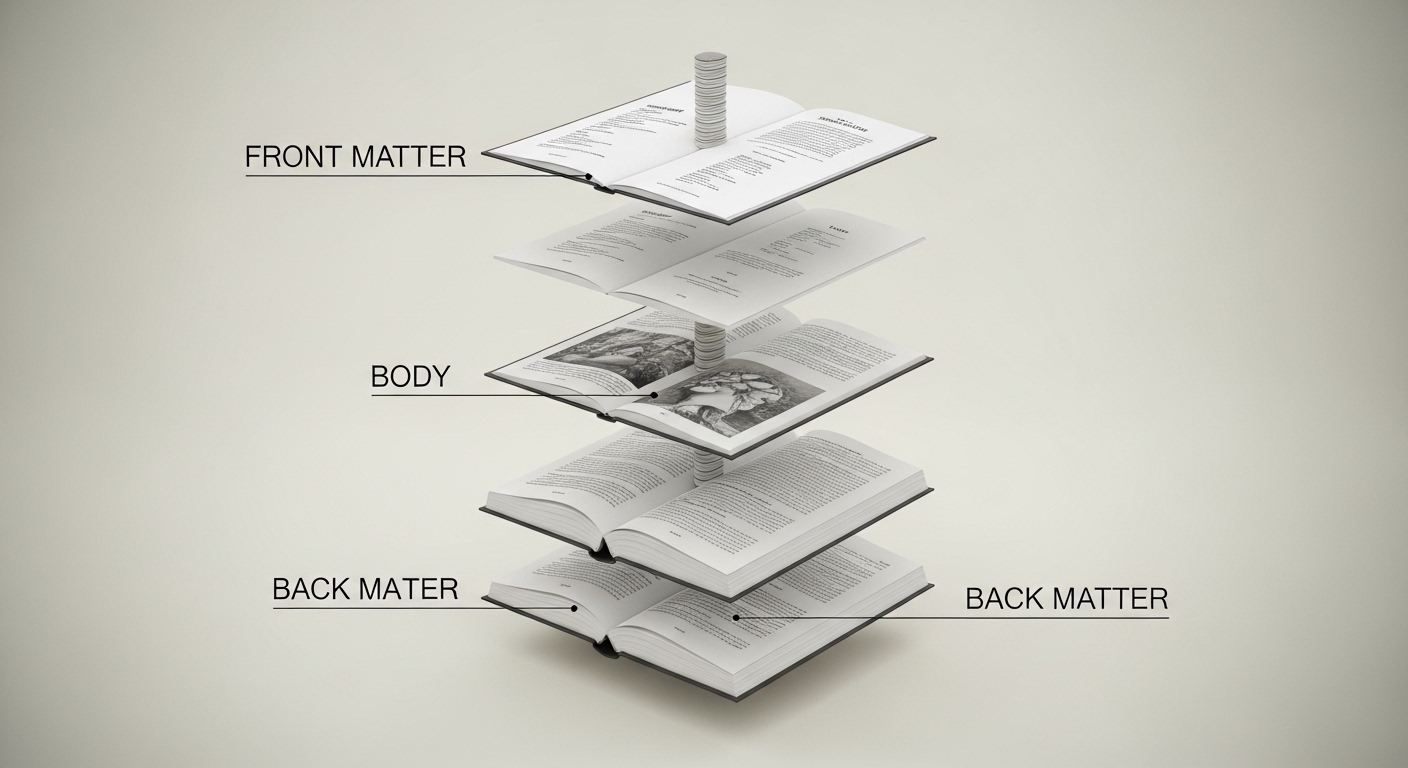
Whether you are an aspiring author, a self-publisher, or an avid reader, understanding how a book is organized is essential. A book is not simply a collection of random pages; it is a carefully engineered vessel for information designed to guide a reader through a specific journey. Professional book architecture ensures that your content is navigable, legally protected, and aesthetically pleasing. In this guide, we will break down the three pillars of book structure—Front Matter, Body, and Back Matter—so you can transform a raw manuscript into a polished, professional volume that commands respect.
1. The Gateway: Navigating Front Matter
Front matter constitutes the very first pages a reader encounters after opening the cover. Its primary purpose is to establish the book’s identity, legal standing, and navigational map. While some pages, like the Title Page and Copyright Page, are mandatory for professional publishing, others, like the Dedication or Foreword, are stylistic choices that add a personal touch or external credibility. In nonfiction, front matter is particularly crucial for setting the stage; it builds trust and authority before the reader dives into the core content.
Key Components of Front Matter
- Title Page: Displays the full title, subtitle, author name, and publisher. (Required)
- Copyright Page: The legal powerhouse containing the copyright notice, ISBN, and disclaimers. (Required)
- Table of Contents (TOC): A roadmap of chapters and major sections. (Required for Nonfiction)
- Dedication: A brief, personal note from the author to a specific person or group. (Optional)
- Foreword: A short introductory essay written by someone other than the author. (Optional)
- Preface: Written by the author to explain the “why” and “how” behind the book. (Optional)
2. The Heart of the Work: Mastering Body Matter
The Body Matter is the reason the book exists. This is where your narrative unfolds, your arguments are presented, or your instructions are given. It typically begins with Chapter One or a formal Introduction. In nonfiction, the body is often organized into parts, chapters, and subheadings to help the reader digest complex information. The structure here should follow a logical progression, leading the reader from foundational understanding to more advanced concepts.
Key Components of Body Matter
- Introduction/Prologue: Sets the scene or defines the scope of the text.
- Chapters: The primary building blocks of the book’s content.
- Parts/Sections: Large divisions used to group related chapters together.
- Epilogue/Conclusion: A final section that wraps up the narrative or summarizes the main points.
3. The Reference Hub: Exploring Back Matter
Back matter, often called the “end matter,” provides supplementary information that supports the body of the book. While the body tells the story or explains the concept, the back matter proves the facts or helps the reader take further action. For academic and technical books, this section is non-negotiable, as it houses the Index and Bibliography, which allow readers to verify sources and locate specific terms quickly. It serves as the ultimate resource for deep-diving readers.
Key Components of Back Matter
- Acknowledgments: Where the author thanks those who helped with the book. (Optional)
- Appendix: Extra data, maps, or documents that support the text. (Optional)
- Glossary: Definitions of specialized terms used in the book. (Optional)
- Bibliography: A list of sources cited in the work. (Required for Research-heavy books)
- Index: An alphabetical list of names and terms with page numbers. (Highly Recommended for Nonfiction)
4. Visualizing the Blueprint: Structural Requirements
To help you visualize how these sections are distributed and what is strictly necessary versus what is stylistic, refer to the table below. This chart highlights the typical order of operations for a standard professional publication.
| Section | Element | Primary Purpose | Requirement Level |
| Front Matter | Copyright Page | Legal protection and ISBN data | Mandatory |
| Front Matter | Table of Contents | Navigation and structural overview | Essential |
| Body Matter | Chapters | Delivering the core narrative or data | Mandatory |
| Back Matter | Bibliography | Citing sources and establishing credit | Mandatory (Academic) |
| Back Matter | About the Author | Personal branding and future marketing | Highly Recommended |
5. Formatting Standards and Pagination Rules
The professional appearance of a book is often dictated by its “hidden” layout rules. In traditional publishing, the front matter is usually paginated with Roman numerals ($i, ii, iii, iv$), while the body begins on page 1 with Arabic numerals. This distinction helps librarians and scholars cite work accurately while signaling to the reader that the “real” journey has officially begun. Using Roman numerals for the front matter allows you to adjust the intro without disrupting the page numbers of the main text.
6. Practical Insights: Avoiding Common Pitfalls
One common confusion for new authors is the difference between a Foreword, a Preface, and an Introduction. Remember: a Foreword is written by someone else (usually to boost the book’s authority), a Preface is about the process of writing the book (the “behind the scenes”), and an Introduction is about the content of the book (the “lesson”). Mixing these up can signal to a professional editor that the manuscript is amateur.
7. The Role of Appendices and Supplemental Data
The Appendix is the unsung hero of the back matter, especially in technical, scientific, or historical writing. It allows the author to include voluminous data, detailed charts, or primary source documents that would otherwise clutter the main narrative. By moving these to the back, you ensure the “Body Matter” remains readable and focused while still providing the “evidence” for your most curious readers.
When structuring an Appendix, treat it as a mini-chapter. It should be clearly labeled (e.g., Appendix A, Appendix B) and referenced within the main body text so the reader knows it exists. Using appendices effectively demonstrates that you have done the work without forcing the reader to slog through raw data in the middle of a chapter. It strikes the perfect balance between thoroughness and readability, ensuring that your core message remains the star of the show.
8. Final Thoughts
Mastering the structure of a book is about more than just following tradition; it’s about respecting the reader’s experience. A well-organized book feels “right” because it follows a logical flow that audiences have come to expect over centuries of printing. By correctly utilizing Front Matter, Body, and Back Matter, you transform a simple manuscript into a professional, authoritative volume. Whether you are self-publishing or pitching to a major house, sticking to these structural norms ensures your work is taken seriously and remains easy to navigate for years to come. Structure is the skeleton that supports your creative spirit; give your work the strong foundation it deserves.
Frequently Asked Questions (FAQs)
1. Is a Table of Contents required for a novel?
Technically, no. Many works of fiction omit a TOC to maintain the story’s immersion. However, for eBooks, a TOC is highly recommended because it allows readers to easily jump between chapters. If your novel has named chapters, a TOC adds a professional touch and helps with digital navigation.
2. What is the difference between a Preface and an Introduction?
A Preface covers the “why” and “how”—the author’s personal journey, the research process, or the inspiration. An Introduction covers the “what”—the actual subject matter, the arguments to be made, and how the reader should use the information within the chapters.
3. Do I need an Index for my nonfiction book?
If your book is intended as a reference tool, an Index is essential. It allows readers to find specific topics without flipping through every page. While it can be time-consuming to create, it significantly increases the credibility and usability of educational or instructional books.
4. Where should I put my “About the Author” section?
In traditional publishing, this usually goes in the back matter. However, for marketing purposes, a brief version often appears on the back cover or dust jacket, while the full biography and list of other works stay at the very end of the back matter.
5. Is the Copyright Page mandatory?
Yes. Even if you haven’t “officially” registered your copyright with a government office, you own the rights to your work the moment it is written. Including a copyright page protects you legally by putting the public on notice and provides necessary metadata like the ISBN and Library of Congress data.


