


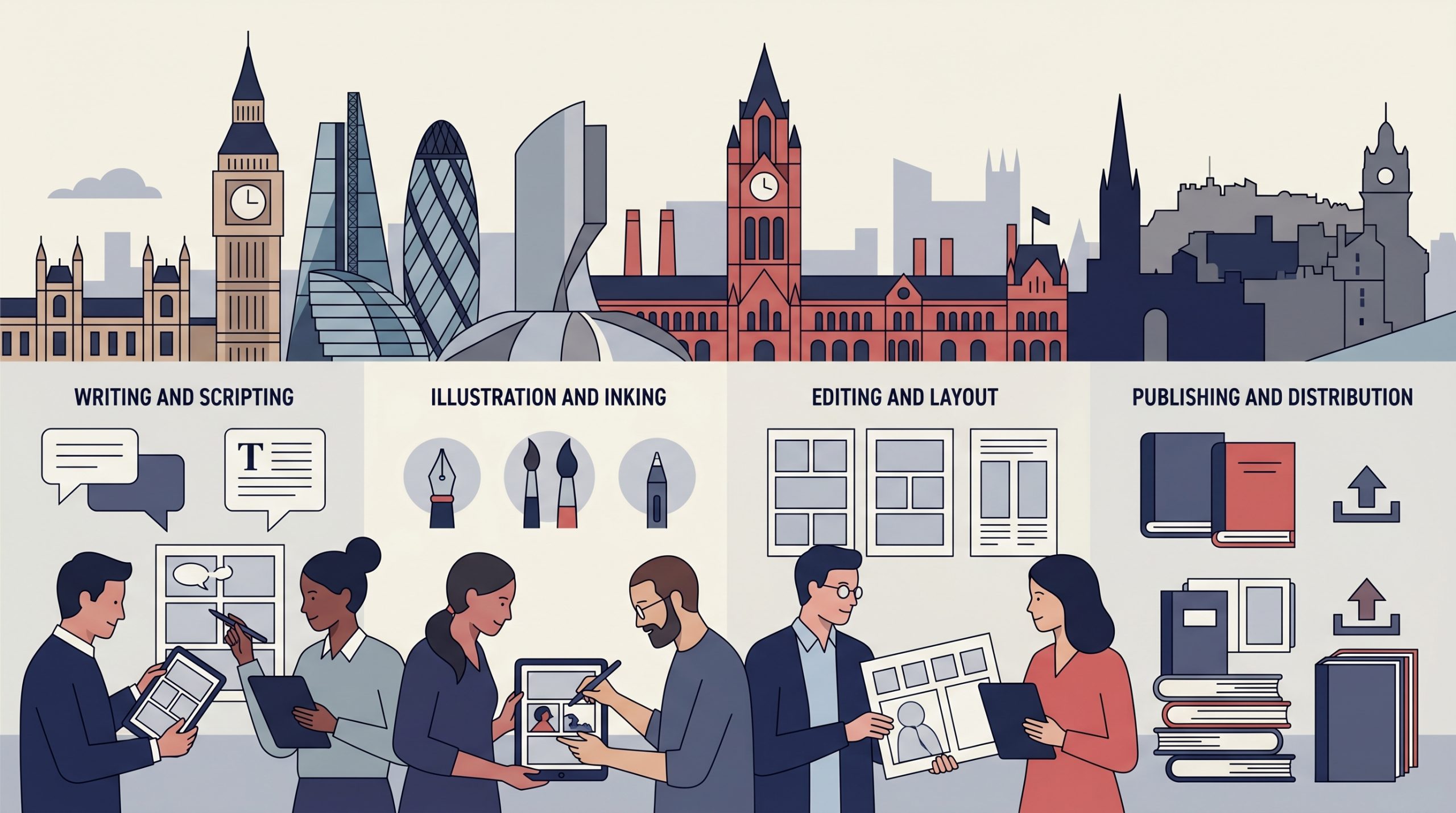
The UK comic book industry has evolved into one of the most distinctive and respected publishing ecosystems in the world. Unlike markets dominated by superhero franchises or mass commercial universes, the British comics scene is deeply rooted in literary storytelling, graphic novel publishing, independent creator culture, and illustrated fiction for both adults and children.
Over the past decade, demand for graphic novels in UK bookstores, libraries, and educational institutions has grown steadily. At the same time, indie comic culture has expanded through festivals, zine communities, crowdfunding platforms, and digital-first publishing systems. This has created a layered industry where traditional publishing houses, independent presses, and self-publishing creators all coexist.
For writers searching for comic book publishers in the UK, understanding how this ecosystem works is essential. It is not a single pathway industry. Instead, it is a multi-entry system where success depends on matching your storytelling style with the right type of publisher.
This guide explores the UK comic publishing landscape in depth, highlights major publishers, explains submission strategies, and breaks down how writers can actually get published.
The UK Comic Publishing Industry Explained
The UK comic industry is fundamentally different from the US model. Instead of being driven primarily by franchises, it is heavily influenced by literary publishing houses, educational book publishers, and independent creator networks.
Most UK publishers view comics as graphic literature, meaning storytelling quality, narrative depth, and emotional structure are just as important as artwork. This is why UK graphic novels often explore themes such as history, identity, politics, relationships, and personal growth.
At the same time, a strong indie culture supports experimental storytelling, self-published zines, and crowdfunding-driven projects. These smaller ecosystems act as entry points for new creators who are not yet ready for major publishing houses.
Broadly, the UK comic ecosystem includes:
- Traditional book publishers with graphic novel divisions
- Independent comic presses and creator-owned imprints
- Educational and children’s graphic novel publishers
- Digital-first and self-publishing platforms
- Indie zine and festival-based publishing networks
How to Get Published in the UK Comic Industry
Getting published in the UK comic market is not simply about having a strong imagination or an interesting idea. Publishers expect a complete professional package that demonstrates not only creativity, but also an understanding of how comics are written, structured, and sold in the publishing industry. Each stage of the process plays a specific role in moving a concept from idea to publication-ready project.
Below is a detailed breakdown of each step.
1. Idea Development
Idea development is the foundation of any successful comic project. In the UK market, publishers are highly selective about concepts because they receive a large number of submissions. A strong idea must go beyond being “interesting” — it must be clearly positioned within a genre, audience, and narrative direction.
At this stage, writers are expected to define what their story is actually about in a precise and compelling way. This includes identifying the central conflict, tone, and emotional direction of the narrative. UK publishers often prefer concepts that feel focused rather than overly broad, because clarity signals strong storytelling control.
A well-developed idea usually includes:
- A defined genre (fantasy, sci-fi, literary fiction, etc.)
- A strong narrative hook that can be explained in one or two sentences
- A clear sense of target audience (children, YA, adult literary readers)
- A unique angle that differentiates it from existing comics
In many cases, weak submissions fail not because of poor writing, but because the idea itself is underdeveloped or too generic. Strong idea development ensures the project has a clear identity before it even reaches the script stage.
2. Scriptwriting
Once the idea is refined, the next step is scriptwriting, which is one of the most critical stages in the entire publishing process. In the UK comic industry, scripts are treated as technical documents for visual production, not just creative writing.
A professional comic script must clearly communicate how each page and panel should function visually. This includes describing action, pacing, dialogue flow, and transitions between scenes. Unlike prose writing, comic scripts must be structured in a way that supports illustrators and editors in visualizing the final product.
UK publishers expect:
- Page-by-page breakdowns
- Clear panel descriptions
- Concise and purposeful dialogue
- Proper pacing for visual storytelling
- Logical scene progression
Strong scriptwriting also reflects an understanding of visual rhythm, meaning how tension, emotion, and story beats unfold across pages. Poorly structured scripts often fail because they are either too verbose or lack visual clarity, making them difficult to adapt into illustrated form.
In short, scriptwriting is where storytelling becomes production-ready.
3. Pitch Package Creation
The pitch package is the most important tool for approaching UK comic publishers. It acts as the complete presentation of your comic idea, combining storytelling, structure, and visual direction into one professional submission.
A strong pitch package typically includes several essential elements. The synopsis provides a condensed overview of the entire story, highlighting the main conflict, tone, and narrative arc. Character sheets introduce the main characters, explaining their motivations, personalities, and roles in the story. These help publishers understand emotional depth and character dynamics quickly.
Another important element is tone definition, which explains whether the story is dark, humorous, emotional, experimental, or educational. This helps publishers determine market fit. Sample pages or script excerpts are also included to demonstrate writing quality and storytelling ability.
Visual references may also be added to communicate art style expectations, mood, or atmosphere.
A strong pitch package functions as a sales document and storytelling blueprint combined, and it often determines whether a publisher requests full manuscript submission or rejects the project early.
4. Submission Strategy
Submitting a comic in the UK is not a random process. It requires understanding the correct channels and choosing the right entry point based on your experience level and project type.
There are several submission pathways available:
Direct submissions involve sending your pitch package directly to publishers that accept unsolicited work. These are often indie presses or specific imprints within larger publishing houses. Writers must carefully follow submission guidelines, as incorrect formatting or missing materials can lead to immediate rejection.
Agent submissions involve working with literary or comic book agents who represent your work to publishers. This route is more common when targeting major publishing houses, as agents help position the manuscript professionally within the industry.
Open calls are occasional submission opportunities where publishers actively request new material for specific projects or anthologies. These are highly competitive but more accessible for emerging writers.
Festival networking is another important strategy in the UK. Events such as comic festivals, illustration fairs, and publishing conventions allow creators to meet editors, showcase portfolios, and build industry connections in person.
A strong submission strategy is about matching the right story to the right publisher and using the correct entry channel.
5. Patience and Follow-Up Discipline
One of the most overlooked aspects of getting published in the UK comic industry is timing. Even strong submissions often take time to receive responses. Publishing houses operate on editorial cycles, meaning submissions are reviewed in batches rather than immediately.
Typical response times range from 6 to 16 weeks, but in some cases, it can take longer depending on workload and publishing schedules.
During this period, writers are expected to maintain professionalism. Constant follow-ups or repeated messages can negatively affect perception. Instead, publishers prefer structured and respectful communication.
Patience also plays a strategic role. Many successful creators submit multiple projects over time, refining their approach based on feedback or market response. Persistence, combined with improvement, is often what leads to eventual acceptance.
Follow-up discipline includes:
- Waiting appropriate time before checking status
- Sending concise and professional inquiry emails if necessary
- Continuing to develop new work while waiting
- Avoiding pressure-based communication
In the UK publishing environment, patience is not passive waiting—it is part of professional behavior.
Top 10 Comic Book Publishers In The Uk
Emerald Ghostwriting
Emerald Ghostwriting functions as a creative development partner for writers who are preparing to enter the UK comic publishing industry. Before a manuscript reaches a publisher, it must be shaped into a structured, industry-ready script that clearly communicates both narrative and visual intent. This is where development support becomes important.
The service helps writers refine early-stage ideas into fully structured comic scripts. This includes developing coherent story arcs, strengthening character motivations, improving dialogue flow, and translating written ideas into panel-by-panel storytelling formats. In comic publishing, especially within the UK market, clarity and structure are essential because editors and illustrators rely heavily on script precision.
UK publishers generally expect submissions to already demonstrate a strong understanding of visual storytelling mechanics. Many promising ideas are rejected not due to lack of creativity, but because they are not formatted or structured in a way that aligns with p
Rebellion Publishing / 2000 AD: The Backbone of British Comics
Rebellion Publishing, through its iconic title 2000 AD, is widely regarded as one of the most influential forces in British comic history. It has shaped the identity of UK comics for decades and continues to define the standard for serialized storytelling in the industry.
At the heart of its legacy is Judge Dredd, one of the most recognizable comic characters globally. The series is known for its dystopian themes, political undertones, and structured episodic storytelling. Unlike many modern comics that focus on standalone graphic novels, 2000 AD thrives on ongoing serialized narratives that build complex worlds over time.
The publisher is respected for maintaining high editorial standards, particularly in pacing, dialogue efficiency, and world-building consistency. Writers are expected to understand episodic structure and deliver scripts that fit within a tightly controlled publication system.
Despite its legacy status, Rebellion continues to accept submissions from new writers. However, competition is intense, and successful pitches usually demonstrate strong command over science fiction themes, structured storytelling, and long-form narrative planning.
This publisher remains one of the most prestigious entry points for writers aiming to enter the UK comics industry at a professional level.
SelfMadeHero: Literary Graphic Novel Publishing
SelfMadeHero occupies a distinct position in the UK publishing landscape by focusing on literary-driven graphic novels and illustrated adaptations. Unlike traditional comic publishers, it approaches comics as an extension of literary fiction rather than genre entertainment.
The publisher is known for adapting classic literature, historical events, and biographical narratives into graphic novel form. This approach allows complex stories to be reinterpreted visually while maintaining intellectual and emotional depth.
Editorial expectations are high, particularly in narrative structure, thematic consistency, and historical or literary accuracy. Visual storytelling is important, but it must support the depth of the written narrative rather than overshadow it.
SelfMadeHero is especially suitable for writers who work with adaptation, educational storytelling, or emotionally layered narratives. Many of its publications are found in bookstores, libraries, and academic settings, reinforcing its position as a literary-focused publisher.
Jonathan Cape (Penguin Random House): High-End Graphic Novel Publishing
Jonathan Cape is one of the most prestigious imprints in UK publishing and operates under Penguin Random House. Its graphic novel division represents the highest tier of literary comic publishing in the UK market.
Unlike indie presses, Jonathan Cape does not function as a traditional comic publisher. Instead, it selects graphic novels that meet strict literary, editorial, and commercial criteria. The focus is on works that can stand alongside mainstream literary fiction in both quality and market appeal.
Projects accepted by Jonathan Cape typically demonstrate strong narrative architecture, thematic sophistication, and a clear artistic identity. Writers must present fully developed manuscripts that show not only creativity but also professional-level execution.
The publisher is highly selective, and submissions are often supported by literary agents or prior publishing experience. Because of its reputation, publishing with Jonathan Cape is
Nobrow Press & Flying Eye Books: Visual Storytelling Excellence
Nobrow Press and Flying Eye Books are known for their strong emphasis on visual identity, illustration quality, and artistic storytelling. Together, they represent one of the most design-focused publishing ecosystems in the UK.
Nobrow Press publishes experimental and artistic graphic novels aimed at adult and young adult audiences. These works often prioritize visual innovation, layout experimentation, and artistic expression over conventional narrative structure.
Flying Eye Books, on the other hand, focuses primarily on children’s literature and illustrated storytelling. It produces high-quality children’s graphic novels that combine educational value with strong visual appeal.
Both publishers maintain exceptionally high production standards, often treating each book as a curated visual object. This means writers and illustrators must think not only in terms of story, but also in terms of design, composition, and aesthetic experience.
Bloomsbury Graphic: Literary Meets Commercial Publishing
Bloomsbury Graphic is part of the larger Bloomsbury Publishing group and represents a balanced approach between literary quality and commercial viability. It focuses on graphic novels that appeal to both general readers and literary audiences.
The publisher handles a wide range of content, including young adult graphic novels, adult fiction, and crossover literary works. What distinguishes Bloomsbury is its emphasis on structured storytelling combined with strong editorial refinement.
Submissions are expected to demonstrate clear narrative arcs, professional pacing, and strong market awareness. The publisher often selects works that can perform well in both bookstore environments and international markets.
Titan Comics UK: Global Franchise & Creator-Owned Publishing
Titan Comics is an internationally recognized publisher with strong operations in the UK market. It is known for producing both licensed comic properties and original creator-owned series.
The publisher works with major entertainment franchises while also supporting independent creators who can deliver commercially viable graphic novels. Its dual structure allows it to operate in both mainstream entertainment and indie publishing spaces.
Titan is particularly focused on global distribution, meaning successful titles often reach international audiences through bookstore chains and digital platforms.
Indie Comic Culture in the UK
The UK indie comic scene is one of the most dynamic aspects of the industry. It thrives through festivals, zine communities, and small press collaborations that support experimental storytelling.
Events such as Thought Bubble Festival and MCM Comic Con London play a major role in connecting creators with publishers, editors, and readers. These environments provide opportunities for networking, portfolio showcasing, and direct feedback from industry professionals.
Indie publishing is often where many creators begin their careers. It allows writers to test ideas, build audiences, and develop storytelling skills without the constraints of traditional publishing.
Self-Publishing Comics in the UK
Self-publishing has become a major force in the UK comic industry. Platforms such as Webtoon, Tapas, Kickstarter, and Amazon KDP allow creators to publish directly to global audiences without relying on traditional publishers.
This model gives writers complete creative control over their work, including story direction, design, and distribution strategy. It also enables direct audience engagement, allowing creators to build loyal readerships over time.
Crowdfunding platforms like Kickstarter further support physical publication by helping creators fund print editions before release.
If you want, I can next turn this into:
Final Insight
Getting published in the UK comic industry is a structured process that blends creativity with industry awareness. Success depends on how well a writer can move through each stage—from idea development to scriptwriting, from pitch packaging to submission strategy, and finally through the waiting and refinement phase.
Writers who approach the process professionally position themselves not just as creators, but as publishing-ready storytellers who understand the demands of the graphic novel industry.


