


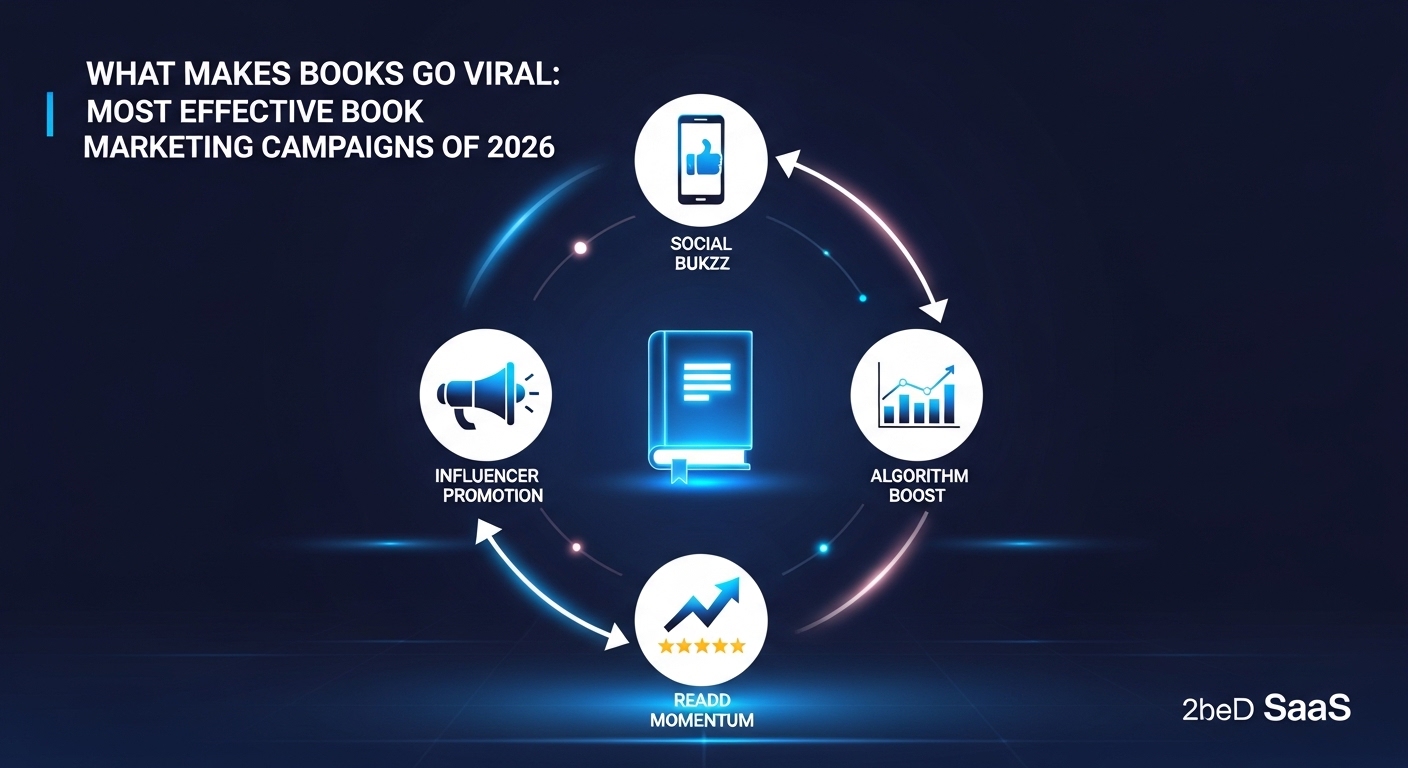
Book virality in 2026 is no longer driven by traditional publicity alone. It is shaped by how well a book can travel across digital ecosystems, social platforms, and reader communities in a way that feels organic rather than forced. A “viral book” is not necessarily the best-written book—it is the book that is positioned, packaged, and amplified in a way that triggers rapid discovery and sharing.
Modern book marketing is less about isolated promotion and more about ecosystem design. A successful campaign connects content strategy, audience psychology, short-form video culture, influencer ecosystems, and reader behavior into one coordinated system. When these elements align, a book can move from quiet release to widespread visibility in a matter of days.
Understanding what drives this shift is essential for anyone trying to publish or promote a book in today’s environment.
The New Definition of a Viral Book in 2026
A viral book in 2026 is defined by momentum rather than initial sales. It is a book that spreads rapidly across platforms due to repeated exposure, social validation, and emotional resonance with readers.
Unlike earlier publishing models, virality is no longer dependent on a single launch event. Instead, it is built through continuous visibility loops where readers, creators, and platforms reinforce each other. A book becomes viral when it consistently appears in conversations, recommendations, and algorithm-driven feeds.
This means the focus has shifted from “launch success” to “sustained discoverability.”
Core Drivers Behind Viral Book Campaigns
Successful book marketing campaigns in 2026 are built on a combination of psychological triggers and distribution strategies. These drivers determine whether a book remains invisible or becomes widely discussed.
Emotional Positioning as the First Hook
Emotion is the most reliable trigger for virality. Books that clearly communicate a strong emotional promise tend to perform better in digital environments because they are easier to share and discuss.
This emotional positioning is not limited to the story itself. It includes how the book is described, how it is visually presented, and how its core message is framed in promotional content.
Books that evoke curiosity, urgency, inspiration, or relatability tend to generate faster engagement cycles. Readers are more likely to share content that reflects how they feel or how they want to feel.
Short-Form Content as the Primary Discovery Engine
Short-form video platforms and micro-content formats have become the dominant discovery layer for books. Instead of discovering books through search or bookstores, readers now encounter them through clips, quotes, reactions, and narrative summaries.
Effective campaigns focus on breaking the book into shareable moments. These may include powerful quotes, emotional excerpts, or narrative hooks that can stand alone without context.
The key is not summarizing the book but extracting high-impact segments that trigger curiosity. Once interest is generated, readers seek out the full content.
Creator-Led Amplification and Social Proof
In 2026, book marketing heavily depends on creator ecosystems. Independent creators, niche reviewers, and content curators play a major role in shaping visibility.
When multiple creators independently reference or discuss a book, it creates a perception of widespread relevance. This is more powerful than traditional advertising because it feels organic and trust-based.
Social proof becomes a multiplier. A book that is seen being read, discussed, or recommended across multiple channels gains credibility much faster than one promoted through single-source campaigns.
Most Effective Book Marketing Campaign Models
While strategies vary, certain campaign structures consistently produce strong results because they align with how audiences consume content today.
Narrative-Based Launch Campaigns
This approach treats the book launch as a story rather than a product release. Instead of announcing a book directly, the campaign builds anticipation through a sequence of narrative-driven content pieces.
The focus is on revealing the journey behind the book, the problem it addresses, or the emotional core of its message. This creates curiosity before the book is even fully visible.
When executed well, the audience feels emotionally invested before the official launch, which significantly increases early engagement.
Community-First Visibility Campaigns
Some of the most effective campaigns in 2026 are built around communities rather than mass audiences. Instead of trying to reach everyone, the strategy focuses on deeply engaging specific interest groups.
These communities may be centered around genres, themes, or shared problems. The goal is to position the book as a relevant and valuable contribution to ongoing conversations within those spaces.
Once a book gains traction inside a community, it often spreads outward organically through recommendations and discussions.
Content Fragmentation Strategy
This model breaks the book into multiple smaller content assets that can circulate independently across platforms.
Instead of promoting the book as a single entity, the campaign extracts insights, quotes, and ideas that function as standalone content pieces. Each piece is designed to attract attention on its own while subtly leading back to the book.
This approach works because it aligns with modern content consumption patterns, where users engage more with short, digestible information than long-form content initially.
Why Some Books Go Viral While Others Don’t
Virality is rarely determined by quality alone. Many well-written books fail to gain traction because they are not structured for visibility.
Books that go viral typically have strong positioning clarity. They communicate what they are about in a way that is instantly understandable. They also align with emotional triggers that resonate with a specific audience segment.
Another key factor is distribution timing. Books that enter conversations at the right cultural moment tend to gain momentum faster because they feel relevant to current interests or trends.
Ultimately, virality is a combination of content strength, presentation strategy, and distribution alignment.
The Role of Reader Psychology in Book Virality
Reader behavior plays a major role in how books spread. People are more likely to engage with books that reflect their identity, challenges, or aspirations.
Books that feel personally relevant are shared more frequently because they reinforce how readers see themselves or want to be seen. This psychological alignment is one of the strongest drivers of organic sharing.
Additionally, readers often rely on external validation before committing to a book. Reviews, creator mentions, and social visibility all contribute to perceived credibility.
Algorithm Influence on Book Visibility
Book discovery in 2026 is largely shaped by algorithm-driven environments rather than direct search behavior. Readers are increasingly exposed to books through recommendation feeds, short-form content, and algorithmic suggestions embedded across platforms. In this system, visibility is not triggered by a single promotional push but by continuous engagement signals that accumulate over time.
What matters most is not just that a book exists online, but how often it is reintroduced to new audiences through content ecosystems. When discussions, summaries, reactions, or quotes related to a book circulate in digital spaces, algorithms begin to interpret that content as relevant and engaging. This creates a feedback loop where visibility grows based on interaction patterns rather than traditional advertising intensity.
How Recommendation Systems Surface Books
Recommendation systems do not “choose” books in a human sense—they respond to behavioral data generated around content related to those books. Every time a user interacts with a piece of content referencing a book, that interaction becomes part of a larger visibility model.
Books surface more frequently when related content performs well in areas such as:
- Completion rates on short-form videos discussing the book
- High engagement on quotes, summaries, or interpretations
- Frequent saves indicating long-term interest
- Repeated shares across social and niche communities
These signals collectively inform the system that the topic is worth distributing further. As a result, books that generate consistent micro-engagements tend to appear repeatedly across feeds, even without direct promotion.
Why Engagement Signals Matter More Than Traditional Ads
Traditional advertising focuses on exposure, but modern discovery systems prioritize interaction quality. A book can be heavily promoted, yet still fail to gain traction if audiences do not meaningfully engage with the content surrounding it.
Engagement signals now function as the primary currency of visibility. These signals include:
- Watch time on video content referencing the book
- Saves indicating future intent or relevance
- Shares that extend reach into new audience clusters
- Comments that generate discussion and secondary engagement
Unlike passive impressions, these signals demonstrate active interest. Platforms interpret this as proof that the content resonates with users, which increases its distribution priority.
How Watch Time, Saves, and Shares Drive Discovery
Each engagement signal contributes differently to visibility growth, and together they form a compounding system.
- Watch time reflects depth of attention and determines whether content is pushed further in recommendation loops
- Saves indicate that users see long-term value in the content, increasing its ranking weight
- Shares expand distribution beyond initial audiences, introducing the book into new social networks
When these signals occur together, they create a reinforcement cycle where visibility increases organically. Over time, this leads to repeated exposure across platforms, which is often the foundation of viral book behavior.
Book Cover + Title as Viral Triggers
Before any marketing system or algorithmic amplification begins, the first barrier a book must overcome is attention. In most cases, that barrier is decided by two elements: the title and the cover. These are not secondary design choices—they function as the first layer of conversion in modern book discovery.
In fast-scrolling environments, readers make decisions in seconds. This means both the title and cover must communicate meaning instantly, without requiring explanation or context. If they fail to do so, the book is typically ignored regardless of its quality.
Why Titles Function as Immediate Attention Hooks
A book title is often the first cognitive trigger in the discovery process. It must create instant relevance or curiosity within a very short attention window.
Effective titles typically work by:
- Introducing a clear emotional or intellectual tension
- Hinting at transformation, conflict, or resolution
- Speaking directly to a reader’s identity or situation
- Creating curiosity without over-explaining the content
In digital environments, titles are rarely read slowly. Instead, they are scanned. This means they must function almost like micro-prompts that immediately signal whether the content is worth exploring.
How Covers Act as Scroll-Stoppers
While titles operate linguistically, covers operate visually. Their primary role is to interrupt scrolling behavior and create a moment of attention capture. This interruption is critical because most book discovery now happens in visually crowded feeds.
Strong covers typically rely on:
- High contrast to remain visible in small formats
- Clear focal points that guide attention instantly
- Minimal visual noise for faster recognition
- Strong thematic alignment with genre expectations
Additional visual behaviors that improve performance include:
- Simple composition that avoids overload
- Recognizable symbols or central imagery
- Balanced spacing that improves readability at thumbnail size
The effectiveness of a cover is measured not by detail complexity, but by how quickly it communicates identity in a compressed visual space.
Importance of Contrast, Readability, and Emotional Framing
A successful cover does not just look appealing—it communicates instantly under real-world viewing conditions. Most readers encounter book covers on mobile screens where size reduction is extreme, making clarity more important than detail.
Key performance factors include:
- Contrast: Ensures visibility even in crowded feeds or small thumbnails
- Readability: Allows titles to remain legible without zooming
- Emotional framing: Establishes mood instantly (curiosity, tension, inspiration, etc.)
When these elements align, the cover and title work together as a unified signal system. This alignment improves recognition speed and increases the likelihood of engagement.
In modern book marketing, these elements are not passive visuals—they are active discovery mechanisms that influence both human behavior and algorithmic distribution.
Frequently Asked Questions (FAQs)
What makes a book go viral in 2026?
A book goes viral when it achieves rapid visibility through emotional appeal, strong positioning, and continuous exposure across digital platforms and creator ecosystems.
Do all viral books rely on social media?
Most viral books today gain traction through social media discovery, but long-term success depends on consistent engagement and reader-driven sharing.
Is book quality enough to make it viral?
Quality alone is not enough. A book also needs strong positioning, emotional relevance, and effective distribution strategies to reach a wide audience.
How important is marketing compared to content?
Both are important. Content provides value, but marketing determines whether that value reaches the right audience.
Can any book become viral?
In theory, yes, but virality depends on timing, audience alignment, emotional resonance, and distribution strategy—not just effort.


