


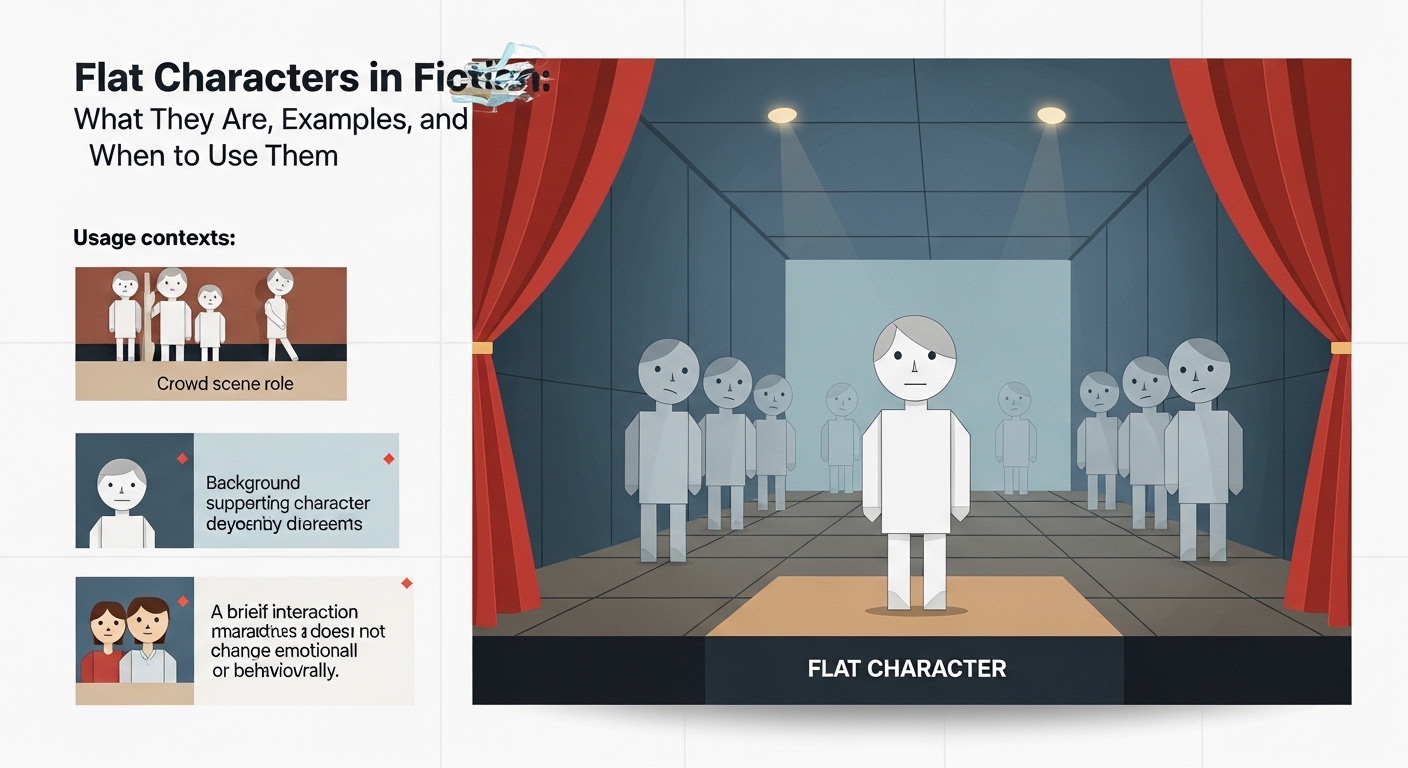
In storytelling, not every character needs to feel like a complex, deeply layered human being with shifting motivations and hidden emotional conflicts. Some characters are intentionally simple, predictable, and defined by a single dominant trait. These are known as flat characters in fiction, and while they are often misunderstood or underestimated, they play a crucial structural role in storytelling.
Writers sometimes assume that “flat” means “bad,” but that is not the case. In fact, many memorable stories rely on flat characters to maintain pacing, clarify themes, or support more complex character arcs. When used correctly, they are not a weakness but a deliberate narrative tool.
What makes this even more interesting is how often readers encounter flat characters without consciously noticing them. They appear in the background of almost every narrative—guiding the plot forward, reinforcing the setting, or sharpening the contrast with more emotionally developed protagonists. A strict teacher in a coming-of-age story, a loyal guard in a fantasy kingdom, or a comedic side character in a modern drama can all serve as flat characters, each performing a specific narrative function without requiring extensive backstory or transformation.
Their simplicity is not accidental; it is strategic. By limiting complexity, writers free up narrative space for the elements that matter most—central conflict, thematic development, and emotional progression of key characters. In fast-moving plots especially, flat characters help prevent the story from becoming overcrowded with competing emotional arcs.
At the same time, flat characters often carry symbolic weight. Because they are defined by a single dominant trait or role, they can represent broader ideas such as authority, innocence, loyalty, or resistance. This makes them especially powerful in allegorical storytelling, satire, and genre fiction where clarity of meaning is more important than psychological realism.
Understanding how flat characters function is essential for any writer aiming to build controlled, purposeful narratives. Rather than viewing them as “unfinished” characters, it is more accurate to see them as precision tools—designed to support structure, emphasize contrast, and keep the story moving with focus and intention.
Understanding how flat characters work—and when to use them—can significantly improve your approach to character development, story structure, and overall narrative clarity.
What Are Flat Characters in Fiction?
A flat character is a fictional character defined by a limited set of traits, often centered around one dominant quality, belief, or function in the story. They do not experience significant emotional growth or internal transformation across the narrative.
Instead of evolving, they remain consistent from beginning to end. Their purpose is usually functional rather than exploratory.
In simple terms, flat characters are:
- Easy to recognize
- Predictable in behavior
- Built around one or two defining traits
- Stable throughout the story
They contrast sharply with round characters, who are layered, emotionally complex, and capable of change.
Flat characters are often used in supporting roles, where deep psychological exploration is unnecessary or even distracting.
Flat Characters vs Round Characters: The Core Difference
To fully understand flat characters in fiction, it helps to compare them directly with round characters, which are their narrative opposite.
Round characters are multi-dimensional. They have conflicting emotions, internal contradictions, and realistic psychological depth. Flat characters, on the other hand, are simplified and consistent.
Here is a clear comparison:
| Feature | Flat Characters | Round Characters |
| Personality | Single dominant trait | Multiple layered traits |
| Development | Minimal or none | Significant growth or change |
| Predictability | Highly predictable | Often unpredictable |
| Role in story | Functional/supporting | Central/protagonist roles |
| Emotional depth | Limited | Complex |
This distinction is not about quality but purpose. Both types serve different storytelling needs. A strong narrative often contains both working in balance.
Why Flat Characters Exist in Fiction
Flat characters are not accidental; they are intentionally crafted for narrative efficiency. When every character in a story is deeply complex, the story can become emotionally overwhelming or structurally unfocused.
Flat characters help writers maintain clarity and direction.
One of their most important roles is story economy—they allow the writer to communicate ideas quickly without unnecessary emotional detours. This is especially important in fast-paced genres like mystery, adventure, or satire.
They also help highlight the complexity of round characters by contrast. When a deeply developed protagonist interacts with simpler characters, their depth becomes more noticeable.
In many cases, flat characters act as narrative anchors, stabilizing the world of the story so that more complex emotional arcs can unfold smoothly.
Common Types of Flat Characters
Flat characters are not all identical. They often appear in recognizable forms depending on their role in the story.
Some of the most common types include:
1. The Loyal Sidekick
A character whose primary trait is unwavering loyalty. They exist to support the protagonist and rarely have independent arcs.
2. The Strict Authority Figure
This character enforces rules, maintains order, or represents institutional power. Their behavior is predictable and rigid.
3. The Comic Relief Character
Designed primarily to entertain, this character often has exaggerated traits and limited emotional depth.
4. The Mentor Archetype
A wise guide who provides direction but rarely undergoes personal transformation.
These archetypes often overlap with the concept of stock characters, which are recurring narrative patterns across literature and media.
Examples of Flat Characters in Fiction
Flat characters appear across all storytelling mediums, from classic literature to modern films. In many detective stories, for instance, police officers or background informants are intentionally kept simple so the focus remains on the investigation and the protagonist’s reasoning process.
In fantasy narratives, royal guards, messengers, or villagers often serve as flat characters whose primary role is to support world-building rather than drive emotional arcs. Even in well-known literary works, flat characters are used strategically. In many cases, servants, minor antagonists, or background officials are not given complex inner lives because their narrative purpose is limited.
In cinematic storytelling, comic relief side characters often remain flat to ensure tonal consistency. Their predictability becomes part of their charm and function. What matters is not how “deep” these characters are, but whether they serve the story effectively.
When to Use Flat Characters in Fiction Writing
Knowing when to use flat characters is just as important as understanding what they are. Overusing them can make a story feel shallow, while underusing them can make it unnecessarily complex.
Flat characters work best in the following situations:
Supporting Roles
When a character is not central to the emotional or thematic core of the story, keeping them flat prevents unnecessary narrative distraction.
Fast-Paced Storytelling
In action-heavy or plot-driven stories, flat characters help maintain momentum without slowing the narrative for backstory or emotional development.
Thematic Reinforcement
Flat characters can represent ideas, systems, or beliefs. For example, a rigid authority figure may symbolize oppression or control.
Contrast and Highlighting
They can emphasize the depth of round characters by acting as a comparison point.
However, flat characters should be used carefully in emotionally driven stories. If overused, they can make the fictional world feel artificial or overly simplified.
The Advantages of Flat Characters
While often overlooked, flat characters bring several important advantages to storytelling. One major benefit is clarity. Readers can immediately understand who a flat character is and what role they play without needing extensive explanation.
They also improve pacing by eliminating unnecessary subplots or emotional digressions. This is especially valuable in shorter fiction, where every scene must serve a direct purpose. Another advantage is consistency. Because flat characters do not change significantly, they provide stability within the story’s structure. From a writing perspective, they are also easier to manage, allowing authors to focus more energy on developing central characters.
Limitations of Flat Characters
Despite their usefulness, flat characters have clear limitations. If used carelessly, they can make a story feel predictable or emotionally shallow. One common issue is lack of engagement. Readers tend to connect more deeply with characters who evolve or reveal complexity over time. Another limitation is repetition. If too many characters are flat, they can blur together and reduce the richness of the fictional world. Flat characters also struggle to carry emotional weight. They are not designed for internal conflict, so relying on them for major emotional turning points can weaken the narrative impact. This is why balance is essential in fiction writing and character development.
How to Write Effective Flat Characters
Writing flat characters is not about neglecting detail—it is about intentional simplicity. The goal is to create a character who feels purposeful rather than empty.
A strong flat character usually starts with a clearly defined function in the story. Once that function is identified, the character is shaped around it without unnecessary complexity.
To make them effective:
- Focus on one dominant trait or belief
- Ensure their behavior is consistent
- Avoid unnecessary backstory unless it supports their role
- Let their actions reinforce their defining characteristic
Even though they are simple, they should still feel believable within the story world. The difference between a well-written flat character and a poorly written one often lies in clarity of purpose rather than depth.
Flat Characters and Modern Storytelling
In modern storytelling, flat characters are still widely used, though audiences are more aware of character complexity than ever before. As a result, writers often blend flat and round traits more subtly.
A character may appear flat in some contexts but reveal deeper layers later, especially in long-form storytelling like novels or television series. This hybrid approach allows writers to maintain both narrative efficiency and emotional engagement.
Still, traditional flat characters remain essential in genres like fantasy, satire, and procedural storytelling, where structure and symbolism are more important than psychological realism.
FAQ: Flat Characters in Fiction
Are flat characters bad for storytelling?
No. Flat characters are not inherently bad. They are functional tools used to support pacing, clarity, and thematic structure.
What is the main purpose of a flat character?
Their main purpose is to serve the story without requiring emotional or psychological development, often supporting main characters or themes.
Can a flat character become a round character?
Yes. In some narratives, a flat character may evolve over time if the story expands their role or emotional depth.
What is the difference between flat and stock characters?
Flat characters are defined by simplicity, while stock characters are recurring stereotypes. A stock character can be flat, but not all flat characters are stock types.
Why do writers still use flat characters today?
They remain useful for maintaining narrative focus, improving pacing, and supporting more complex character arcs without overwhelming the reader.
Final Thoughts
Flat characters in fiction are often misunderstood, but they are far from meaningless. When used with intention, they provide structure, clarity, and balance within a story. They allow writers to focus on emotional depth where it matters most while keeping the narrative grounded and efficient.
In many ways, flat characters are the quiet framework that supports the more dynamic elements of storytelling. Understanding how and when to use them is a key step toward mastering character development and narrative design.


